Perfect Safari?

This post is about a safari that happened at the end of February and beginning of March. Having been away from home for nearly 3.5 months things have been hectic in the office and as a result it's been difficult to sit down and write this blog. Tomorrow I head to Tarangire for 4 weeks of practical guide training with a group of great guide candidates. Things have been hectic as I coordinate and advise training that over 160 guides in Tanzania will participate in one form or another. These are exciting times in Tanzania... but more on that later. 

I have selected moments of the last safari to write about, rather than the whole thing, although if one wanted a perfect itinerary, it wouldn't be pretentious to say this could be it. 


Experiencing Serengeti

Part 1

The Short Grass Plains (Day 4 & 5)

We pulled into our camp set up on the edge of the short-grass plains of the Serengeti, laughing over the rocky road wondering how close we were to the end of the world. We were the only guests in camp, a camp I love and have stayed in numerous times in a small concession called Piyaya. There’s a lot more to a camp than the equipment and food that the chefs can produce, and I love this 6-tent camp partly because it’s always just beyond where everyone else goes. Few agents can use it because the experience won’t fit into the predictable boxes of what they can safely sell. I like it because it opens up the opportunity for spontaneous experiences- another thing agents can’t sell and safaris many guides hate guiding. But for a few of us, this is what we love.

The VHF radio crackled and I could just make out the voice of a good friend and guide- Masenga.
Baado niko nao”. (I’m still with them)
Goodluck, another Maasai guide, explained;
Yuko na mbwa”. (He’s with the dogs)

I hadn’t told my guests about the dogs because I get animated when I talk about them and if we hadn’t found them it would have been a huge disappointment. It had been a long day, but guests or no guests, I was going to see the dogs. Postponing the hot bucket showers that were being hoisted up behind the tents, we set off in Masenga’s direction.

In my experience, African wild dogs typically sleep until 6 or 6:30 p.m. before they begin a ritualized and joyful waking up ceremony which involves chasing each other around, begging for food, reestablishing social positions and then a hunt. It was actually a ritual that established one of my own rituals when I worked in Piyaya with Masenga which was to depart for sundowners on a hill around 5:00, glass the wildebeest covered plains with binoculars until the dogs emerged and then follow them as they chased wildebeest across the plains.

Hearing Masenga’s voice on the radio brought back those memories. We set off and the video explains the rest.
 
day 2 and more on facebook
African wild dogs, also known as Painted hunting dogs, are rare. There are fewer wild dogs left in Africa than Black rhino, though no one really knows for certain how many there are. While the loss of wild dogs in Africa is primarily due to land encroachment, they have also suffered at the hands of revengeful pastoralists and game managers who once considered them vermin and would shoot them on sight. They are not feral dogs, and although they belong to the same family as dogs, they belong to their own genus called Lycaon. Dogs, wolves and jackals belong to the Canis genus.

Wild dogs are considered the most efficient hunters on the savannahs and in the miombo woodlands. Hunting cooperatively in packs, they take down prey from the size of hares to wildebeest and zebra. Showing unbelievable endurance, they can run at speeds of 60 km/hr for extended periods of time, wearing their prey down. They catch more prey than any other carnivore especially on the grassy plains of the Serengeti, where they hunt without the tense stalk of the cats, and instead just rush into the herds of wildebeest.

African hunting dogs are particularly interesting in their version of cooperative breeding. Individuals in a pack live within a rank system with an alpha male and female at the top who dominate breeding. Rarely do other dogs in the pack get the chance to breed and if they do they risk losing the puppies to the alpha. The alpha female may have up to 16 puppies that are born blind in a den and begin to emerge after about 2 weeks. This is a taxing time for the other dogs that cannot range as far as normal but must return to the den to regurgitate food.

As I write this, I have received news that the alpha female whelped and two days later lost all the puppies when torrential rains flooded the den.

Having had a wonderful experience with the wilddogs, we set off across the plains through the hundreds of thousands of wildebeest in the direction of Ndutu. Having been alone at the previous camp, it took some time to get used to other vehicles again, but we were rewarded with some great sightings including a cheetah with her 4 small cubs. 


Part 2.
Northern Serengeti

Rounding the Serengeti experience off, we flew to Sayari camp to finish the safari part of our trip alone again. Having spent three weeks there with Nick Brandt (read here), I was eager to find the lions that I’d written about and see how they were doing. Our first drive took us up into the Wogakuria kopjies where we found a leopard and his mother and spent the afternoon watching, photographing, and sipping wine.


Taking advantage of being alone in the area, and the freedom that comes with it, we were up early the next morning and ventured a little further afield with a packed breakfast in the hope of finding black rhino. The only evidence of rhino we succeeded in finding was rhino tracks and the rhino had obviously retired into the dark shade of some riverine thicket where we couldn’t follow. Instead, a courting lion couple allowed us very close.

The landscapes in this region of the Serengeti are stunning and we spent a good portion of the time driving around remarking at its beauty. The wildlife was a bonus, and by the end of the few days there we had seen lions hunting, cubs playing, lions mating and on our last night were rewarded with an iconic view as 9 lioness walked off into the sunset.


Part 3.
Gorillas.

I’ve now written quite a few articles on visiting the gorillas and without using pretentious vocabulary, it remains one of the most powerful wildlife encounters.

The tourism warden joined us for drinks the evening before our trek and we were fortunate to be able to hear first hand about the struggles of managing the national park, but also how important tourism is for conservation.


Requesting a relatively easy group to see, we set off from the car park through the potato fields to try to find the Agashya group. As usual, trackers had already set off in the morning and as we came close to the National Park we were surprised to see the trackers sitting on a rock only a short distance from the famous rock wall boundary. We were quickly briefed on the etiquette of gorilla watching, and were then interrupted by a young gorilla feeding on the wall. After a half hour of watching the gorillas in the forest within sight of the wall, they all moved out of the forest and proceeded to gnaw on eucalyptus bark. It was the clearest I’d seen them and interesting to watch them out in the open.

My Lions


‘Born Free’, by Joy Adamson is the first book I remember reading. I think that it was the book I was being read when I realized I could read faster myself than having someone read to me. I loved the stories of camping in the bush for long periods of time, the adventures of walking and driving through the bush on expeditions, and of course having your own lion to accompany you in the bush. As much of a dream of mine as it was, I never imagined I would end up driving around the bush, climbing rocky outcrops to watch the sun go down, or sneaking up on elephants at a waterhole on foot. I don’t own a lion to take with me on walks, but I work in one of the most amazing places on Earth, and sometimes that’s as good as owning it.
What a treat!
I’m currently in Serengeti for three weeks with a photographer, trying to photograph lions. Lions spend 16-22hrs of the day sleeping, but if you get up early enough you often see them moving around, or at least sitting up. They actually often hunt around 2 p.m. when everyone is back in camp having dessert and getting ready for their siestas.

 
Male lions roar tomake contact with other lions in their pride, and to let intruders know how strong they are. This is the most handsome lion of the Sayari pride. To really appreciate this, you need to plug speakers in or wear headphones.

I started working in this area 6 years ago when I was running Suyan camp, just outside the park. It was a beautiful camp and I have some special memories of walking the area with a couple of Maasai, my teaching them the English names of birds and plants, and their teaching me their traditional uses for plants. The concept behind the camp was to provide opportunities that couldn’t be had in the park like night drives, walks, and sundowners on ridges with bonfires. Sometimes I would convince guests to take the mattresses off their beds and we would arrange them around the fire and sleep under the stars.

Occasionally we would drive across the northern part of the park to the edges of the Mara River. The area had been closed to tourists for a period of time because of a rise in poaching and some violent encounters between tourists and poachers. Resident wildlife numbers were down, but during the dry months elsewhere in the Serengeti, this area got rain and the migrating wildebeest would move in. I won’t go into details of why wildebeest migrate, but I’ve written about it on another blog (safari ecology). Working together with Serengeti’s rangers, and also working in the villages adjacent to the park, Asilia took a risk and put up a camp called Sayari. When Suyan had no guests, I would pop over to Sayari and help out with the guiding. Sayari was a success, and within a couple of years other companies got the drift and now, during the dry season, this is one of the busiest areas in the national park.

Busyness is not necessarily negative, and tourists on game drive are effectively extra rangers on patrol, which makes operating quite difficult for the poachers, so poaching decreased when the tourists arrived. Lions were scarce at that time, as was other game, but the population of wild animals began to increase. It took three years for Asilia to build the first permanent camp here, and in doing so they set the bar for luxury camps in Serengeti. I began coming here in the off-season, when the wildebeest weren’t here, helping out with the walking safaris. Then last year, when I came up in March, I saw over 50 lions here (see blog).  This explosion in the lion population is evidence that there’s also more prey.

Lions live in prides made up of a core of females, usually related. Prides are territorial, and the more females in a group, the more successful they are at keeping intruding prides out, and also expanding their territories when food is scarce. Larger prides also have higher success rates of raising cubs. Males take over prides when they fully mature at about 5 years old. In order to be reproductively successful, a male lion needs to rule a pride for at least 2 years, which is long enough for his cubs to reach independence. This forces lions to form coalitions to keep intruding males out. It is still too early in this area’s renaissance to see much stability, and therefore pride territories and dynamics are ever-changing. However, some of the prides are growing.

The pride above Sayari consists of 2 male lions. Coalitions of 2 males are often not related, though coalitions of 4 or more are. In this case, one is older than the other. There are at least 7 lionesses in this pride and there are 12 cubs that were born sometime mid-December.
 The Cubs.
Such an amazing sight. The mothers killed a zebra this morning in an epic ambush. There will be plenty of milk to go around. These poor two lionesses were being harassed by all the cubs who were thirsty. 

As I follow the pride for the next couple weeks, I will enjoy it on my own for the most part. In a way, it is the dream that I’m living.

Congo III: Volcanoes


--> -->
The new volcano from 350m. Photo by Gian Schachenmann
The day before we boarded the Rwandair flight to Kigali en route to Congo, I received a link from a friend equally passionate about adventure to a youtube clip from Cai Tjeenk Willink (the Director of Tourism). It was breaking news: sometime in the evening, on the 6th of November, a loud bang was heard marking the beginning of a new eruption. We’d planned to climb Nyarigonga, the famous active volcano that in 2002 had sent a river of lava out of a fissure on the southern side, down Goma’s main street and covering a third of the airport runway. The volcano itself, at 3,468m, has a crater just over a km in diameter, and in the middle sits the world’s largest lava lake. Our plan was to sleep in the cabanas on the rim to enjoy the night view of the glowing molten rock. 

Driving around the south-east of Nyarigonga, we couldn’t wait to see the new eruption. As we glimpsed the first ash and lava spraying into the sky, we excitedly stopped the driver and dragged pelicases and tripods onto the bank of the road to get photos. Little did we know that we’d have fantastic views from the lodge at Rumangabo and the gorilla camp at Bukima. Upon arrival at Mikeno Lodge, we immediately wanted to know if we could walk in to see the new volcano. The delegation of heavily armed rangers had not returned yet from their safety assessment of the area, so Sarah was hesitant to commit.
The volcano from Bukima ranger post. by Gian Schachenmann
That evening from the crest of the hill, we watched the earthen firework display light up the sky, and we slept to the sound of the repetitive explosions nearly 15 kilometers away.

Three days later, escorted by 12 rangers, we set off as the first visitors to see the eruption. The path was narrow and overgrown and footing precarious as we picked our way over the lava flows from an eruption that had occurred in 1977. I couldn’t help but notice the prime example of succession; lichens covered the 34 year old rock and in the cracks, moss and ferns had started to grow. Other than that, there were a few pioneer shrubs and small trees that were establishing themselves where enough organic matter had accumulated.
Glowing lava. by Gian Schachenmann
Fountains of lava. By Gian Schachenmann
As we neared the volcano, the explosions became louder and our footfalls began to crunch gravel spread by the eruption. The camp was basic, having been carried in the day before when the volcanologist and head warden had walked into the site.  We dropped our backpacks and hurried closer. 300-400m was close enough and we could feel the warmth on our faces. We sat mostly in silence, mesmerized by the sound and sight of the liquid rock building a new mountain. Already in the few days since we’d first sat on the hill watching, a cone had formed. As darkness approached, the explosions became louder and we were showered with light stones. The ambient light faded, and the light from the volcano intensified. We retreated to camp and slept with our tents open, listening and watching as the fountains of lava lit up the sky.


Congo II. Mountain Gorillas of Congo

Kabirizi, a magnificent silverback. Phot by Gian Schachenmann

In a country devastated by genocidal colonial rule, torn by kleptocracy, warring militia groups, and swamped with refugees, it is a wonder that Africa’s oldest national park, Virunga National Park, has managed to survive. The more time we spent walking around the headquarters, the more I was impressed by the Congolese Nature Conservation Institute (ICCN), headed in Virunga by Emmanuel de Merode. The heavily armed rangers who looked more like soldiers were evidence that not everything is peaceful, yet there was an optimistic air that begged us to bring tourism.

The MAN made for a bumpy but fun ride!
We climbed into the back of the 4wd MAN lorry that the ICCN had converted to transport guests on the horrific roads and slowly crawled up toward Bukima ranger post to begin our gorilla trek. The steep, rocky and sometimes slippery 12km road took us nearly an hour and a half to climb, through fields of bananas, cassava, pole-beans, and arrow-root and again, hundreds of children running out to wave. Whereas in most places in East Africa the adventurous route is a chosen option, the route we were on was the only way up the mountain. Wheels spinning and the massive engine straining, we made the last meters to the edge of the forest.

Without the ceremonial briefings of Rwandan gorilla trekking, after registering our names on a random piece of paper, we set off through the fields of potatoes and tobacco that crept right up to the edge of the forest. Startling us, a child ran whooping towards a patch of potatoes, giving us a glimpse of a couple beautiful l’Hoests monkeys as they scampered for safety in the forest. It was fairly easy walking and within an hour we’d reached the spot that would give us the easiest trek through the rainforest to the Kabirizi group that the trackers were monitoring. Compared to Rwanda, the forest trekking was easier. I don’t know how our ranger found the trackers because his radio battery died, but after only an hour we found ourselves with a very large group of gorillas.
Photo by Gian Schachenmann
Mountain Gorillas live in family groups led by a dominant male- an impressive massive animal weighing upward of 500lbs distinguished by the white-haired saddle on his back that earns him the title of Silverback. The pioneer research on Mountain gorillas was conducted by George Schaller, also a pioneer lion researcher in the Serengeti, but their plight was made famous by Diane Fossey and her book, “Gorillas in the Mist”. 

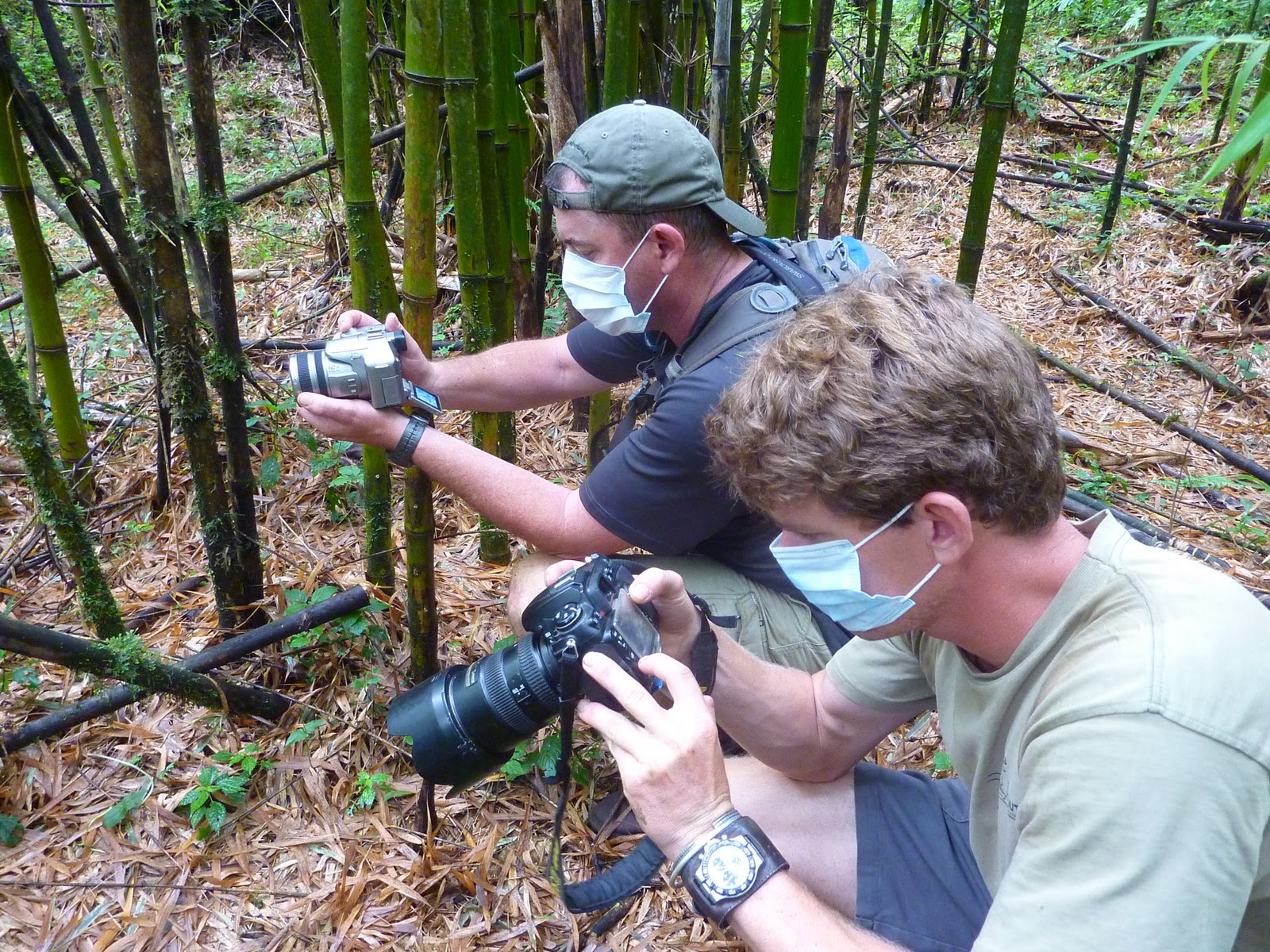
Donning our surgical masks, a precaution to protect gorillas from the various diseases we potentially carry to which they have no natural immunity, we began the precious hour. Kabirizi, a large and intelligent Silverback, took control of the group in 1998 his predecessor was caught in crossfire between the army and rebels. He acquired more females fighting other silverbacks, and now holds one of the largest groups, nearly 5% of the world’s Mountain Gorillas. We followed the family as they moved through the bamboo forest feeding on shoots and young stems, and we were rewarded with some commanding viewing.


With only 820 Mountain Gorillas left, a human disease would be a disaster.
The next morning we found the Humba group (14 individuals) and again enjoyed their calm company for the hour we were allowed. Although there is a minimum distance from which to observe the gorillas, it is sometimes impossible to get out of the way quickly enough should they walk toward you. At one point, when we were backed up against a bamboo clump, I was thrilled at the trust a female showed. Casually walking past us, her tiny baby clinging to her side, she stopped only a few meters away to pull a piece of Sticky-willy that had stuck to the baby’s hair.


Congo I: Journey to Congo


There are a few experiences on safari that rate themselves as extra special above others. There’s something about walking through the bush where you become vulnerable, or sitting in the midst of elephants with their intimate social interactions. I highly rate sitting on a hill with a 360 degree view with hundreds of thousands of wildebeest gnu-ing around you, but I don’t think there’s much that can prepare you for that 1 hour with a gorilla family.

The 300kg Silverback crosses his arms and stares at you, then scratches his head, while a youngster looks at you and then does a summersault before looking back at you as if he wants to know that you’re still watching, or if you’re going to play.
The Virunga Volcanoes
I knew our trip to see Congo’s gorillas was going to be a real adventure when we crossed the border at Goma. We spoke to the immigration official in Swahili, handing him our passports and photocopies of our visa approval through the window with Expats written over the top. I don’t want to dwell on the pessimistic perspectives of Congo written up in most articles, but the stories of officials confiscating passports and then demanding bribes or “recovery fees” did pass through my mind. He reached to a drawer in his desk and pulled out a cardboard folder with a hand-written piece of paper with a list of names, nationalities, and passport numbers. Our names were all spelled correctly, but the nationalities were jumbled not to mention the passport numbers. It didn’t seem to matter and he nonchalantly ticked our names off and corrected the nationalities. Our passports were passed to another official along with some mutterings in French, while we waited for the $50, 14-day visa, recently negotiated by the conservation body for tourists.

We stopped at the ICCN office to pick up our permits before driving north to the park headquarters and newly built Mikeno Lodge. The excitement was hard to contain. In stark contrast to Rwanda where the roads that tourists see are all paved and clean, and the experience offered a highly polished and organized system that you’d expect in Switzerland, Congo was the opposite.
Like any other town?
Goma itself is a town occupied by the UN- mostly Uruguayan, Indian and South African troops who live in fortified compounds with watchtowers and drive around in jeeps and helicopters spending approximately $3million per day. Congolese soldiers walk around heavily armed with Kalashnikovs, RPD’s and rocket launchers, while pickups with music systems and flags blast political slogans and music, campaigning for the up-coming elections.

Blood hounds being trained to help rangers.


As we drove through the countryside we were astonished at the number of children running out to give thumbs-up and ask for pens and biscuits. As in Rwanda, the volcanic soils are intensively farmed and appear very productive, just less orderly. We remarked how few were the small kiosks selling basic necessities like soap. It is obviously a hard life and everywhere we looked, the scene cried out with a story. As we drove into the headquarters on the edge of the forest, one could not help notice the old grand administrative buildings that spoke of a different era. Yet despite the evidence of deterioration, the result of decades of turmoil, there is an atmosphere of hope and positive change. 
(photos by Gian Schachenmann)

Beautiful rooms at Mikeno Lodge.
A wonderful breakfast before gorilla day.... stay tuned!

Tanzania's Great Rift Valley Lakes & Mountains

As if the dry season is attempting its final life sapping effort to suffocate us before the rains come, an apocalyptic dust storm is sweeping across the southern shore of Lake Natron. Agitated by the dark, threatening thunderstorm, the dust is diffusing the afternoon rays of sun giving Oldonyo Lengai an eerie glow as the dust slowly envelopes the volcano.

Driving from Amboseli to Lake Natron the other day, I took a cross-country route through the plains between four prominent volcanoes. The volcanic dust, like talcum powder enveloped the vehicle billowing into the car through every space possible. Building cumulonimbus clouds inspired graphic dust devils on the barren landscape. Zebra, Fringe-eared oryx, Grant’s gazelle, Thomson’s gazelle and giraffe stood in the shade of the few Acacia trees resting in the heat of the day.

Lake Natron, where we’re headed is the largest of the Great Rift Valley’s soda lakes and is also the most caustic lake in the world. It is extremely shallow, no more than 3 meters deep. Lying at 610m above sea level it also gets extremely warm and water temperatures regularly reach 40C (60C recorded), combined with a pH of 9-10, it’s surprising that life can actually flourish. Microorganisms that love the salt give it amazing shades of red, greens and crystal white.

Lesser Flamingos use this lake as an important breeding ground, protecting their eggs and hatchlings by building little mounds in the water far enough away from the shore that predators have to seriously think about venturing out. They also specialize in feeding on the algae- Spirulina that blooms in these waters. There’s also an endemic fish- the Magadi Tilapia that concentrate in the hot springs that feed into the lake.

A year ago, travelling with Nick Brandt on safari, we drove to Natron in search of calcified birds. We scoured the shores picking up a variety of birds including hornbills, flamingoes, starlings, doves, bee-eaters, mouse-birds, and Quelea that had been mummified by the salts in the water. The small invertebrates, fish, and bats that stood frozen in their death pose were fascinating. Click to see his photos of what we found.

A mixture of Sodium bi-carbonate (baking soda) and Sodium carbonate is called Natron, and is the same substance that was mined in Wadi el Natron in Egypt 5000 years ago by the Egyptians when they began mummifying their pharaohs. The alkali salt loves water and absorbs it, drying whatever it has come in contact with. Its alkalinity is also anti-bacterial which helps to stop bacterial decay.


A few days after we arrived here, it rained. The dust finally settled, and you could almost hear the animals breathing a sigh of relief. We drove out into the plains in front of Kitumbeine Mountain visiting all the little parasitic craters at the base of Gelai, Kerimasi and Oldonyo Lengai. The green grass already sprouting, we counted hundreds of zebra and wildebeest on the plains and spent some time just sitting and watching. In the evening we drove up Lengai as far as the track goes and sat watching the afternoon light sending moving shadows through the valleys and ridges, reflecting Shompole in the lake. 

Another Weekend in Tarangire


Finding myself back in Arusha for a couple weeks between safaris, it wasn’t long before I was wishing I was back out in the bush. With guests going into Matembezi’s private camp in Tarangire, I was invited by the owner to head out and spend the weekend there before the guests arrived on the Monday. The fridge full of beer, binoculars on the dash, and a spare set of clothes and other essentials, we left the traffic jams and noise of Arusha on the familiar road to Tarangire.

Looking through my blog it hadn’t occurred to me how much time I’d spent this year in Tarangire and after this weekend, I have to admit scores very high on my favorite places list. I was excited to get out there with my brother, girlfriend and some other friends not working as the guide or teacher, but just for fun. I’d get to look at some of the little-brown-jobs (LBJ’s) as birders call them, or stop to try to identify a fairly non-descript plant.

Just the drive into camp was wonderful, the 500 elephants in the swamp beginning to head out into the woodlands, a leopard in a tree next to the road. A lion in a tree, 3 pythons in trees, and of course the tranquil vistas. Maybe its because this was the first park my parents brought me to as an infant, but it always has a calming effect on my soul.

We woke up early on Saturday morning and drove out towards the swamp onto a beautiful green lawn, the result of a grassfire followed by rain. Within 300 meters from camp we spotted two lionesses feeding on a hartebeest and then watched as a hyena approached, urging the lioness to drag the carcass into the bushes. Surrounding us was an aggregation of Bohor reedbuck, Impala, Grant’s gazelle, Hartebeest, Eland and even a rare Fringe-eared Oryx wandered past, as we sat on the roof sipping fresh coffee. We continued on our little game drive only to bump into a pride of 14 lions- 10 cubs and 4 lionesses, before returning to camp for breakfast.


The Sausage trees were flowering and attracted Scarlet-chested Sunbirds who flitted about chasing each other away from their flowers. But the real highlight was the number of antelope that the fallen flowers attracted. At any one time, we could see at least 7 different species and all in all we saw a total of 12 species within a couple kilometers from the camp. The burned ground had also attracted a species of bird that I’d never seen before called the Chestnut Sparrow-lark as well as beautiful Collared Pratincoles.

Sunday came, and we returned to Arusha, revived by a couple nights in the African bush.

Antelope species seen:

1.     Eland Taurotragus oryx
2.     Greater kudu Tragelaphus strepiceros
3.     Lesser kudu Tragelaphus imberbis
4.     Bushbuck Tragelaphus scriptus
5.      Fringe-eared oryx Oryx beisa callotis
6.     Common waterbuck Kobus ellipsiprymnus
7.     Bohor reedbuck Redunca redunca
8.     Coke’s hartebeest Alcelaphus buselaphus cokii
9.     Grant gazelle Gazella granti
10.  Impala Aepyceros melampus
11.  Kirk’s dikdik Madoqua kirki
12.  Steenbok Raphicerus campestris