Showing posts with label Wildlife. Show all posts

The Gorilla Story Part 1. Some Insight into Mountain Gorillas.


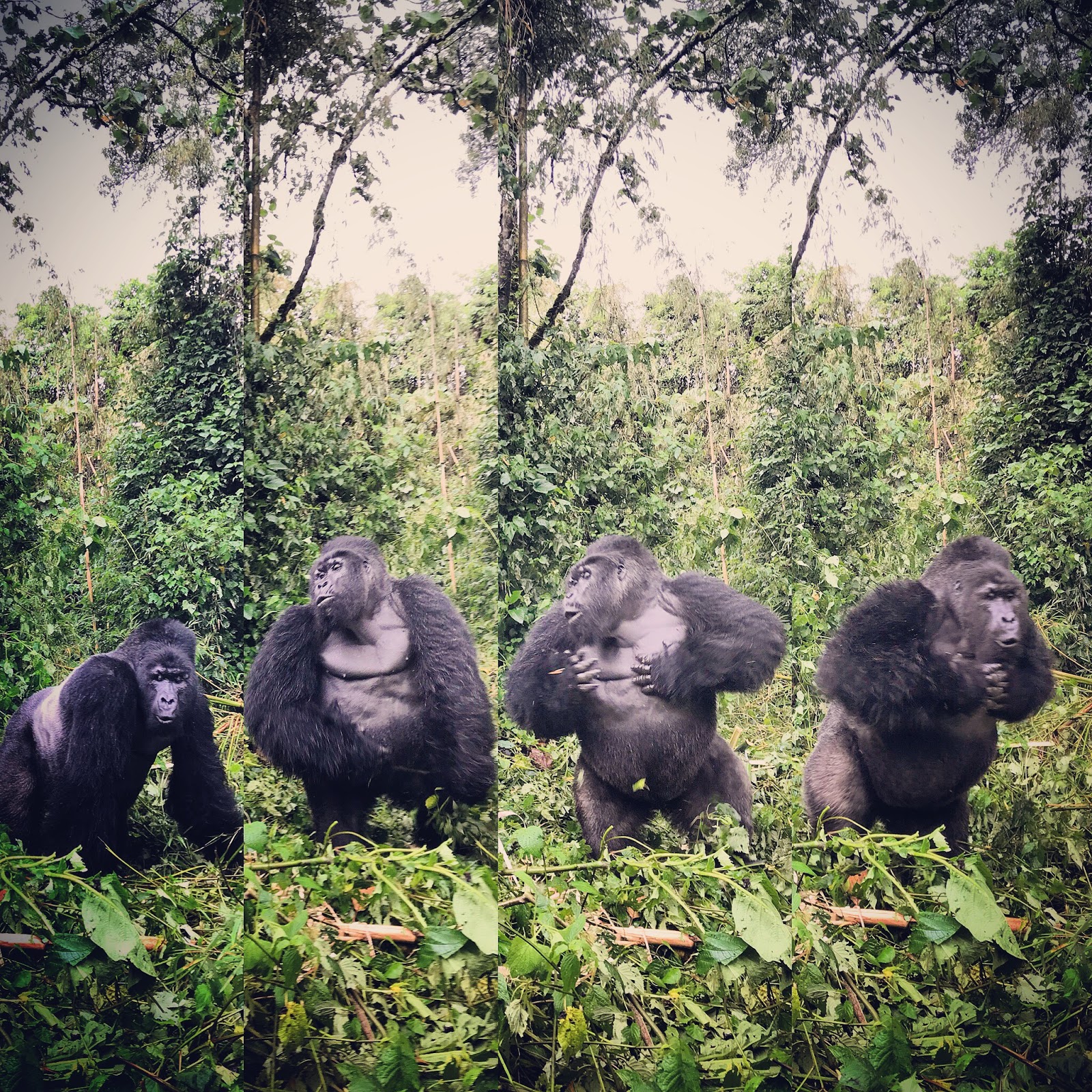
Kasole of the Munyaga group beats his chest for us! Watch a video here. Who is Kasole? Find out here. 
 Having returned from guiding my nineteenth gorilla trek in fourteen months, I thought I’d share some of the insight that I have gained so that if you are considering a trip to see mountain gorillas you have more than the standard info pack you might receive from standard operators.

I personally prefer trekking in Virunga National Park in the Democratic Republic of Congo. The experience is slightly less regimented, sometimes disorganized, but is undoubtedly more intimate. The history of the gorilla groups in this article therefore applies to the groups in DRC, however, the Mountain gorillas are essentially the same wherever you are in the Virunga Massif. 

Below are some frequently asked questions (see my next post for some history into the make up of the six of the gorilla groups you’ll most likely visit in DRC):

How many species of gorillas are there?
There are 2 species of gorilla- the eastern gorilla (Gorilla beringei) and the western gorilla (Gorilla gorilla). The former is found in Virunga and split into two subspecies- the Mountain Gorilla of which half live in Virunga National Park, and the Eastern Lowland Gorilla (Gorilla beringei graueri) found in northern parts of the park and in Kahuzi-Biega National Park south of Lake Kivu.

How many mountain gorillas are left in the wild?
This question is a bit of a misnomer because mountain gorillas don’t survive outside of the wild. In fact, the only place where they survive in captivity is at the orphanage at Mikeno Lodge. While the results of the 2016 census have not yet been released, the estimates are that there are now over 1,000 mountain gorillas in the wild, between Bwindi National Park in Uganda, and the Virunga Massif. Stay tuned for up-to date information.

How big is the area that the mountain gorillas live in?
The amount of land that mountain gorillas have in the Virunga massif is on 447km2. You can clearly see the pressure of humans on the land when you look at a satellite image of what is left of the forest. An initiative by the Virunga is buying land adjacent to the park to replant bamboo and expand the area available to the mountain gorillas.
The forest (East) of the N2 in DRC is home of the Mountain gorillas. As you can see, the area of land in DRC is much greater than that in Rwanda.
 What do mountain gorillas eat?
Mountain gorillas are vegetarian but occasionally will raid a nest of safari ants (Dorylus sp). and sometimes eat mushrooms. They select from over 60 different species of plants but their favourite is bamboo which may make up to 90% of their diet during bamboo shoot season. The rest of the time, over 75% of their diet consists of 3 species: (Galium ruwenzoriense, Peucedanum linderi, and Cardus nyassus). A big silverback can eat up to 30kg per day. 

The blue sign represents the new park boundary for bamboo project. Expanding the habitat for Mountain Gorillas.  The forest in the distance is the current park boundary and limit of Mountain Gorilla habitat.
Are gorillas territorial?
No. Mountain gorilla groups live in overlapping home ranges that vary in size from 3 to 34 km2 depending on group size and food availability. They tend to move less than 1 km per day, resting and feeding for about the same amount of time. Occasionally when they encounter other groups or danger they will travel further, but not usually more than 3 km in a day.

What do you mean by a silverback?
The term silverback refers to a full-grown male gorilla. Male gorillas mature somewhere between 9 and 10 years old. At this time they are already much bigger than the females and the hair on their backs begins to turn white or silver. Somewhere between 12 and 15 years old, they reach their full size and can now begin to compete for females. They are now considered a silverback.
Humba's son poses for the camera. Who is Humba? Read this post.
While the specific make up of each gorilla group is different, gorilla groups are led by a dominant silverback. It isn’t completely straight forward and there’s a lot that is going on that we can’t see, but it seems that females choose who to follow. Remember, these are highly intelligent primates. Dominant silverbacks will usually tolerate other silverbacks in their group either because they are their sons, but occasionally they will also tolerate non-related silverbacks in the group- it is after all advantageous to have a strong coalition when they do encounter other gorilla groups to help guard the females from being abducted or convinced to join the other group. Silverbacks are very protective of their groups and will display and act violently towards perceived threats including lone males and other gorilla groups.

How do you tell the difference between a male and female gorilla?
It is actually quite difficult to tell the difference between a young male and young female gorilla unless you see the penis. Gorillas have internal testicles so you can’t go by that visual cue either. However, adult gorillas exhibit sexual dimorphism (the fancy word for males & females looking different)- mainly in size and the obvious “silver-back” of a fully mature male. An adult male gorilla can weigh more than 155 kg which is almost twice what a big female weighs (80kg). If you could look at their skulls, you’d also see that the males have bigger skulls with a very pronounced sagittal crest. This is the attachment for the chewing muscles. They also have fairly large canines.

What is a gorilla’s life like?
Babies are born after a 255-day gestation period. They weigh about 2kg at birth. Twins are sometimes born, but it is very stressful for the mother and they rarely survive. 18% of infants die in the first six months- and the mortality is higher in the wet season because of respiratory diseases. Another 16% will not make it to 3 years, but after that they have a good chance of surviving to adulthood (8 years).

Females mature at 7-9yrs and usually have their first baby at 10. From then on they have babies about every 4 years for the next 20 years. When males mature, they will often leave the group they were born into and join small groups of males or become solitary hoping to start their own families. Mature females also leave the groups they were born into and either join other groups or solitary males to form new groups.

What is a typical day on a gorilla trek?
Usually somewhere between 6 a.m. and 7 a.m. small bands of trackers and rangers head out to find the gorilla groups. They do this regardless of whether any tourist is going to visit for monitoring purposes. Because the gorillas tend not to move that far, the trackers head out to where they saw them last and begin tracking from there. 

Meanwhile, back at the ranger’s station, you are waiting for the registration process to begin. You’ll have your permit in hand and you fill in your details including passport number into a book and then sit down to wait for a briefing. It is fairly simple in Virunga, because there are fewer groups, and fewer people visiting, so you all sit in one room and the head ranger explains gives a short explanation of the gorilla groups and which ones you will visit. When you are ready to go, the rangers distribute facial masks and ask you to sanitize your hands.  At this point if you would like a porter to help you with your bag (and hold your hand on the slippery slopes) they are waiting outside ($15 fee per porter paid directly to the porter). You can also buy a walking stick for $10.  Once this is done you head off on the walk. The rangers have a fairly good idea of how long it will take to get to each gorilla group so you head off through the fields adjacent to the park to one of the numerous paths that enter the forest. When you enter the beautiful forest you head along a network of paths to where the trackers have found the gorilla group that you will visit. The trek can be anywhere from 20 minutes to 3 hours. You leave your bags and take only your cameras. I recommend carrying an extra camera battery and memory card in your pocket because you will likely take a lot of photos and video. You will don your mask and slowly approach the mountain gorillas. The rangers will vocalize to the gorillas to let them know that everything is ok and you will begin your 1 hour with the gorillas. This is non-negotiable, but if you want to spend more than 1 hour per day with gorillas, and have a relatively good fitness level- contact me. In my experience, the rangers are keen to get you in good photographic opportunities so sticking close to them often gets you in the best places. Your hour will go by fast. Then it is time to head back to the ranger post where your trek ends.  
Sometimes all you need is an iphone and a cool hat.
How should I behave in front of the gorillas?
·      Be silent in the presence of the gorillas.
·      No smoking
·      No eating or drinking
·      Do not stare or point directly at the gorillas
·      NO FLASH photography
·      Follow the guide's instructions/actions.
·      Move slowly and calmly
·      Should the Silverback charge, do not run.
·      Keep behind the guides.
·      No children under 15 in Rwanda, no children under 12 in DRC (non-negotiable)
·      Wear the surgical mask provided by the rangers in the presence of the gorillas.

Gorillas are highly susceptible to most human diseases and if you are knowingly carrying a contagious disease (especially flu) please DO NOT attempt to trek. This is because they are so closely related to us: read this awesome article about how close we are.

How fit do I need to be and what if I can’t walk?
This is one of those questions where the ideal fitness and minimum fitness are going to differ greatly. Mountain gorillas are found above 1,800m above sea level (5900ft). The forest paths are uneven and can be slippery- and any given group could be from 500m to more than 10km from the ranger post. Of course it is very unlikely that you will find that all the groups are deep in the forest or far away- the shortest walk I ever did in DRC to see Humba was less than 200m, but I’ve also walked for 3hrs with fit people to get to a group. The rangers will take your fitness or ability to walk into consideration but you should be able to walk a couple miles and be able to deal with some hills. If you are unfit, definitely hire a porter to hold your hand. Remember, a lot of it is in your mind. If for one reason or another you cannot walk, but would like to see the gorillas, it is a great opportunity to inject some cash into the local economy. Many of the villages in DRC are inaccessibly by car so the people have large woven baskets called Kipois that they use to carry people who can’t walk (or royalty) to roads. It costs $250 to be carried to a gorilla group.  

What should I wear for the gorilla trek?
The key things to think about when packing for Rwanda or Congo are as follows:
·      There is a high potential that you will encounter wet weather,
·      The trekking can be slippery and steep and you may need to scramble over fallen logs
·      There are stinging nettles in the forest that can be quite uncomfortable when brushed against, and there are safari ants known locally as Siafu that can also be unpleasant.
The essentials to wear:
·      Strong waterproof walking boots
·      Wicking sock liners and hiking socks- it is really useful if you can pull your socks up over your long trousers to prevent ants from crawling up your pants. Gators can be very useful as an option.
·      Long sleeved shirt (or risk nettles)
·      Long trousers/pants helps with nettles. I often just wear my rain-pants over shorts.
·      Sunscreen SPF 30 or more
·      If you need glasses or wear contacts carry an extra pair of glasses
Things to have in your day pack:
·      Warm fleece
·      Rain jacket/ poncho
·      2 spare batteries & 2 extra memory cards
·      drinking water
·      high-energy/protein snack
·      personal pertinent medication
·      valuables like passport and money
Additional optionals:
·      Insect repellent (Avon Skin So Soft is an effective insect repellent) but there are few biting insects that you will encounter in the forest.
·      Binoculars (not necessary with the gorillas) but if you like birding there are some spectacular birds
·      Garden gloves

What camera lenses should I take?
This is always a little bit of a tricky question to answer because it depends on the type of photo you are looking for. I only use my iPhone which also takes good video but is quite limiting- I can’t get the close up of the eyes etc. If you are a wildlife photographer and you have two camera bodies you’ll want a 24-70mm and a 100-400mm lens. If you can only have one of the above- the 100-400mm lens will be most versatile. The ability to open up the aperture and lets as much light in will also be very useful in the forest which can be quite dark. There is always a chance of rain when you’re with the gorillas so make sure you have a way to keep your cameras and equipment dry. There are some awkward but nifty rain-jackets for cameras that allow you to continue taking photos when it is raining.

You’ll be surprised how many photos you take so make sure you have plenty of memory, spare batteries and a way to back your photos up.

The other thing to consider if you are a serious photographer is that during the one hour you spend with the gorillas, you’ll only have a fraction of the time when the conditions are right for the photo you’re looking for- whether it is light, gorillas posing, or whatever you are trying to capture. This makes it essential to do more than one trek. Furthermore, you’ll often spend the first 30-45 minutes just getting used to the shooting conditions.

What are the difference between visiting the gorillas in Rwanda & DRC?
There is no difference in gorilla behaviour between Rwanda and DRC except for the natural difference between individuals and groups.

·      The maximum number of people per trek in Rwanda: 8
·      The maximum number of people per trek in DRC: depends on the gorilla group size- 4 if the group has less than 10 individuals, 6 if the group has more than 10.

·      Minimum age in Rwanda: 15 yrs
·      Minimum age in DRC: 12 yrs

·      Cost of gorilla permit in Rwanda: $1,500
·      Cost of gorilla permit in DRC: $400 high season, $200 low season (contact me for low season dates).

·      Obligatory to wear a surgical mask in DRC for the protection of the gorillas.

·      More accommodation options in Rwanda
·      Rangers speak better English in Rwanda

·      Registration process in Rwanda is done by your driver/guide
·      Registration process in DRC is done by yourself

·      Habituated gorilla groups in Rwanda: 10
·      Habituated gorilla groups in DRC: 8 but only 6 accessible from Bukima

The Gorilla Story Part II. A Brief History of the Gorilla Groups in DRC.

If we needed a species as an icon to represent the conservation of Virunga National Park, in the DRC, it would be the Mountain Gorilla, or Gorilla beringei beringei, as it is known to taxonomists. In fact, it could be argued that without Mountain gorillas, the National Park, established in 1925 and formerly known as Albert National Park, wouldn’t exist today. Paradoxically, it was two collectors of gorillas for museums that recognized the unsustainable collection of Mountain gorillas. Charles Akeley who collected for the New York Museum of Natural History, and Prince William of Sweden with their prominent connections were able to lobby the Belgian King and gather international support to establish the protection of Mountain gorillas.

The gorilla story in DRC takes us back to 2 legendary silverbacks, Zunguruka and Rugendo who each led a habituated group of gorillas on different ridges in the forest behind Bukima ranger post. Both were habituated in 1986.  

A white board in the rangers office at Bukima showing the group make up. Key: SB: Silverback, BB: Blackback, ADF: Adult Female, SUB: Sub-adult, Juv: Juvenile, Beb: Baby.

Current lead Silverbacks in the six groups accessible from Bukima Ranger Post:
Kabirizi group: Kabirizi
Bageni group: Bageni (Kabirizi's son)
Nyakamwe group: Nyakamwe (Humba's brother, son of Rugendo)
Humba group: Humba (Son of Rugendo)
Rugendo group: Bukima
Munyaga group: Mawazo (& Kasole)

Two stories:

Rugendo

Zunguruka
If all of Rugendo’s sons are his, he could potentially be one of the most successful silverbacks to have led a gorilla group. At the time that he led it, it was a large group of 18 individuals. His son's names are highlighted in bold-italic.

Rugendo was tragically assassinated on the 15th July, 2001, in crossfire between warring militias, however, his genetics and legacy live on.

Rugendo had many sons
-       Mapuwa

Left his father’s group in 1998, with two females.

-       Humba
-       Nyakamwe
Humba left with his brother Nyakamwe in 1998. In 2014 they interacted and split into two groups.

-       Senkwekwe
Senkwekwe took over the group, though as a young silverback he lacked the strength and experience to keep the group intact. Some of the females left, joining his brother’s group Mapuwa. Senkweke was murdered together with five other gorillas in 2007.

Bukima  (not Rugendo’s son)
Is currently the dominant silverback of the Rugendo group. Kongoman and Baseka are both with him. 
-       Kongoman
-       Baseka

-       Ruzirabwoba is a solitary silverback.


Zunguruka got his name from the habit of walking in circles. He had two sons, Ndungutse and Salama who took over the family when Zunguruka died of old age.

In 1994, a wild silverback showed up on the scene and fought with Salama and Ndungutse. He did not win, but the wounds he inflicted on Salama eventually killed him leaving Ndungutse as the sole silverback.

The wild silverback was named Kabirizi.

In 1997, Ndungutse was assassinated. His sons Buhaya and Karateka took over the group, and after a series of fights, Karateka ended up as a solitary silverback.

At this point, Kabirizi returned to the scene and killed Buhaya. The females however refused to follow Kabirizi and were led by the oldest female Nsekuye.

At this point Munyaga, a lone silverback entered the scene and took over the group being led by Nsekuye. It wasn’t long before Kabirizi challenged Munyaga, this time winning and taking with him all the females. Munyaga remained with a small group of sub-adult males. Then in 2007 he went missing during a surge in rebel activities. At that time, Mawazo led the group although he was still a Blackback. He eventually matured and was able to acquire females of his own with his brother Kasole. 

Kabirizi continued to succesfully lead his group that grew to 36 individuals. Then in 2013 he suffered a blow when his son Bageni, who had grown up to become a formidable Silverback, challenged him taking with him 20 individuals, including his mother, brother, and 2 sisters.

Adventures in Serengeti

The following photos are all taken with my iPhone on three safaris through the northern Tanzania, with Serengeti as the feature.
I'll start with a photo of the guides who co-guided with me on the trips. It is common knowledge that the guides make a trip, they keep you safe, host you, and give deeper insight into the wildlife and ecology of the savanna. With no more than four guests per guide we keep a ratio that ensures everyone gets the right amount of attention. Thank you Robert Tarimo and Paul Oliver.
The theme of many of these photos could be about big sky. This male giraffe seems dwarfed by the plains and sky. Since I only use my phone for photos, I don't use any zoom. This photo was taken en-route to Asilia's Namiri Plains Camp. Because of my previous work for Asilia, I am one of few guides allowed to drive in the camps where they normally only want people guided by their guides.

Again- the skies in the Serengeti provide this impressive backdrop fro wildlife viewing. This photo was taken on Christmas day. If you look carefully you can see one of the vehicles (driven by Paul Oliver who guided with me on this trip) to the left of the big rock kopjie. You can't see the lions they were watching.


Without using a zoom you'd have to be in a park with very habitated black rhinos to get a close up just using a phone. This is a black rhino and her calf only a few hundred meters from where we camped. Unfortunately rhino poaching still continues and there are very few rhino that are still left in Serengeti.

I'm often late for lunch- and on this occasion we were nearly back in camp but found this pod of hippos basking in the sun along the banks of the Mara river. While things are getting busier every year, this part of Serengeti is very quiet outside of migration season and while some of the animals are harder to find, it is a great place to be alone especially.


An elephant herd feeding along the main road at Bologonja. While flying between camps is often the most efficient way to maximize the wildlife experience, driving the vast distances does give you an understanding of the vastness of the ecosystem.
This old male lion was pretty beaten up but still trying to keep up with the pride. When the wildebeest move out of the north, lion prides that have had it easy suddenly find their territories tight and must venture further to find food and keep alive. This often leads to territorial fights between neighboring prides. Prides often divide into subgroups that are easier to feed, but this creates issues for the males who now risk their lionesses running into nomadic or roaming males.

A picnic breakfast in the Serengeti can be a 5-star buffet or a tailgate affair as below... as long as there is hot coffee I'm fine.

The choice of accommodation is yours. Do you want the ultra-luxury that Mwiba or Singita properties offer or would you rather keep it simple as below. For me, safari should be about the wildlife experience and the landscapes. With good guides, the experience you have at either the luxury or the simple camps will be very good.

Cats on rocks... doesn't get much better than this. It was pretty hot in the morning but with 15 cubs, these lioness were hungry. We found them walking along the road before they climbed onto these rocks to get a better view of prey in the long grass.


A Small Selection of iPhone Video Snippets from a Northern Tanzania Safari

A lot of people are surprised when I tell them that Spotted hyenas are actually very efficient hunters and actually scavenge an average of only a third of their prey in places like Serengeti. When they hunt, they are usually quite successful- especially when more than one hyena goes on the hunt. The statistic- 1 in 3 attempts if there are more than two hyenas. In this case, it was broad daylight and these hyenas took on this wildebeest in Ngorongoro Crater. After a significant chase they brought it down next to the road. 10 minutes later, more than 25 hyenas had arrived and all that was left was a bloody stain on the ground.

I caught this little clip of this beautiful male lion walking across the Serengeti plains very close to the Kenyan border. Lions spend so much time sleeping during the day that it is fun to just see them actually moving. With the wildebeest migration moving through the area, his pride was looking well fed. Watching such a perfect specimen is so rewarding- and knowing that he is safe deep at the heart of this massive National Park.

During the dry season June through October, the 1.5 million wildebeest in the Serengeti ecosystem head north into an area of the ecosystem that receives a much higher rainfall throughout the year than the more fertile soils in southern Serengeti. It’s during this period that the famous wildebeest crossings happen. This video shows them coming from the northern side of the river to the south. Their movements are based on local localized rainfall so it is difficult to predict. After a very successful full morning of game driving we decided make one pass along the river before heading back to camp, when we found this mass of wildebeest standing on the edge of the river. After uhming and aahing over whether to jump or not, they actually turned back, but were met by another group heading towards the river. Joining forces they finally stepped into the water and the crossing frenzy began.


This cheetah mother was very attentive while her cubs fed from a gazelle she had just killed. Cheetahs in general have a hard time raising cubs. Cheetah cubs are born hidden in “dens” and are fairly helpless. They are tiny and that first 4 months of their life are easily killed by lions and hyenas- 89% of cubs die during that time. Only 4-6% survive the first year- but what is quite intriguing is that success is not equally distributed among the females. Over half of female cheetahs in Serengeti never manage to raise a single cub to independence, while there are a few “super-moms” who manage to successfully raise litter after litter.


This last one is not a video- but an image. No safari would be complete without spending time with elephants. it is always so encouraging and reassuring to see baby elephants. Serengeti National Park is the only park in Tanzania that has seen a rise in the population of elephants. No one is sure whether this is because of reproduction or whether human pressures like poaching outside the park are driving the elephants into it. Grumeti Reserves, a former hunting concession has invested in efficient anti-poaching so hopefully these elephants are safe- unless they decide to wander back onto village lands.

Follow me on Instagram!

Beyond Ruaha's Charismatic Wildlife

An exploratory guide's-only trip.
Greater kudu- a flagship Ruaha species.
There’s a triangle in Ruaha National Park, bordered on the south side by the Mdonya river, the escarpment running north east, and on the east to south side by a section of the Ruaha River’s floodplain. Through the middle runs a sand river, the Mwagusi, creating an incredible area for the charismatic wildlife that gives East Africa its reputation. Like many places in East Africa, water is the limiting resource that determines wildlife abundance, and the Ruaha, Mwagusi and Mdonya Rivers provide just that- permanent (though not always obvious) water for herds of hundreds of buffalo, elephants, giraffe, zebra, impala, yellow baboons, and their predators: lions, leopards and cheetah. But it is a relatively small area in Ruaha’s extensive landscape.

Our first stop was a campsite on the Mdonya River. It was the end of the dry season, so water was limited to a few places where elephants knew to dig. We’d just driven 15 hours straight from Arusha, but were sighing in relief as the familiar sounds of the African bush comforted our souls. None of us bothered with the rain flies for our tents and went to sleep to the sound of the African scops owl. Lions roared as the walked by at about 4 a.m. but it wasn’t until the ring-necked doves started their morning call to work that Tom, our camp assistant, woke up to stoke the fire and get the coffee going.
Our first campsite under a Lebombo wattle (Newtonia hildebrantii).
Day 1.
Our first order of the day was a meeting with the tourism warden and a couple of rangers to discuss our expedition. Some recently opened roads were making access into some of the least visited areas of the park possible and we wanted to know if they would work for walking safaris. For many of us, walking is a way of experiencing a quieter side of nature and escaping from the diesel-engine-run game drives and trappings of luxury camping. Waking up to a thermos of coffee and going to bed after a sipping whiskey by the fire were all the luxury we needed; it was about the wilderness.
The magical triangle in Ruaha- see map below for context.
As we left the magic triangle we climbed up into the hills behind the escarpment and were rewarded immediately by a racquet-tailed roller who fluttered along side. “Lifers” were being added to the list and for most guides with passion like us, that is one of the most exciting things. The next lifer for a few of us, only a few minutes later, was a herd of Sable antelope: one of the most beautiful of all antelopes, and particularly exciting as they are miombo woodland specialists. The miombo woodland was also changing in anticipation of the rains, and with colors that would compete with a Vermont autumn. Vivid reds, purples, blue-greens, light greens; it was beautiful.
With 7 of us in the vehicle, food for 8 days, camping equipment, and our libraries, water was our biggest challenge. The 90 litres we could carry required us to take every opportunity we could to refill, and determined our campsites over the next few days. 

We arrived at the first campsite as the evening light became intense and vibrant and what unfolded became the schedule for the next week: unload, set up tents, collect firewood and light fire, unpack and prep dinner, carry the basin to the stream to bathe and then sip on a cold beer, reclining on thermarests, binoculars on chests, and reference books open. We didn’t need to meditate or even think about focusing on the moment; it just was, pure, the product of a love of wilderness and like-mindedness. Sleep came quickly, as it does in the bush. 
Racket-tailed rollers.
Day 2
As the night sky began to change, the fire was stoked and coffee water boiled. Each of us woke to our own beat, grabbed a cup of coffee and the first moments of the day were appreciated in respectful quiet.

With heavy rainstorms imminent we followed Thad’s suggestion and headed to the furthest point we wanted to reach. The grass got greener and longer as we drove around the Kimbi Mountains. We saw more game that day: sable, zebra, giraffe, warthog, Lichtenstein’s hartebeest and even some lions. However, to say that wildlife was prolific would be very misleading.

Lichtenstein's hartebeest- a miombo speciality.
On maps, the Mzombe-roundabout appears to be the headwaters of the river. It is also on the border of the park; in essence, the end of the road. The grader driver literally created a cul-de-sac roundabout. In the past, the Petersons had walked the Mzombe River further downstream before trophy hunting and administration in the bordering Rungwe Game Reserve had become so profit-oriented that they stopped respecting the buffer to the park and hunted right to the edge. Yet, the Petersons’ stories of encounters with lions, elephants, hippos and more had left an impression of this river, one that was not fulfilled at the headwaters. 

Incredible flowers.
A natural bouquet. Nature does it better.
Delicate Orchids- Eulophia coculata.
Instead it was incredibly green, and the hills invited walking. It had obviously rained enough to bring out the wildflowers and on the walk the next day in addition to wonderful birds like thick-billed cuckoos, spotted creepers, and yellow-bellied hyliotas, we admired the proliferation of flowers.

Day 3
Having walked for 7 hours in the morning, we returned to camp for lunch. The clouds were building and we had already been dumped on while walking. We packed up camp, and made our way back around the mountain. Our third camp was at the base of the mountains in a small clearing. Purple crested turaccos hopped around in the trees and as darkness fell, barred-owlets, tiny little owls, began calling.
Water re-filling break under a Faidherbia albida.
Day 4
The next morning we set off early, and were fortunate to quickly find a proper elephant trail leading up into the hills. Elephants are big animals and just naturally take the best route. The switchbacks were there when we needed them and the path that wound its way up around rocks and to the top of the hills made it a real pleasure to climb the hill. A rocky outcrop distracted us as we paused for peanuts, homemade cookies and water. More new birds made our list but a particular highlight was 2 sightings of Chequered elephant-shrew. 
Photographs cannot capture the extensiveness of this wilderness.
We returned to camp at around 3, exhilarated by the climb. Lunch was quick and we headed off to a clearing we had passed a couple of days before that we believed we could drive down to get to a river known as the Lupati, a tributary of the Mzombe. We barely made it half a kilometre when the woodland became too thick to drive through. Small drainages were converging and a couple of times we ran into dead-ends. We did have good sightings of Roan antelope and that evening as we watched nightjars hawk the sky, we heard our first elephants.

Just a lunchtime chill.
Day 5
Spectacular storm build-ups warned us that we should probably head back to the Ruaha River, so after our usual breakfast we took a shorter walk before proceeding to head towards Usangu. We entered the new addition to the national park and drove and drove. It was a long day of driving, but the landscape kept changing as we pushed on. It was not until we made it into the lower areas that we began to see more wildlife, particularly giraffe and impala. There was evidence of game and in one clearing we had great sighting of sable, roan, and bush pigs foraging in daylight. Scuff marks and tracks in the road told a story of Africa wilddogs killing a warthog.
Roan antelope- another Ruaha speciality.
We arrived in camp as it was getting dark. Camp was on the river, just meters from a pool with over thirty hippos in it. We quickly set up camp before settling down on the riverbank to watch the birds fly by and hippos grunt their disapproval of their new neighbors. As darkness set in, we scanned the water for crocodile eyes- 1, 2, 3, 4, 5, 6 pairs of eyes watching us.

Day 6
The sun had not come up yet, but the sky was changing. Coffee cups in one hand, binoculars ready to train on birds flying by, we sat and watched. This was really a grand finale for us. It was a slightly slow start but this was the area we would most likely come to walk next year and I wanted to explore. We set off for a couple of hours and then returned to take the vehicle. There were campsites we needed to examine and stretches of river to see. The roads had not been graded as they had the previous days, and the going was tough enough that my vehicle is being repainted as we speak. A stump wrote off a tire, but those are the costs of adventure.
Pel's fishing owl.
Day 7
It was the usual morning routine, but as we sipped our coffee and contemplated the view, we knew we were leaving today. We took down our tents and then took a quick walk along the river before climbing back into the vehicle for the ride home.
To book an adventure in Ruaha contact me or Thad.