Congo III: Volcanoes


--> -->
The new volcano from 350m. Photo by Gian Schachenmann
The day before we boarded the Rwandair flight to Kigali en route to Congo, I received a link from a friend equally passionate about adventure to a youtube clip from Cai Tjeenk Willink (the Director of Tourism). It was breaking news: sometime in the evening, on the 6th of November, a loud bang was heard marking the beginning of a new eruption. We’d planned to climb Nyarigonga, the famous active volcano that in 2002 had sent a river of lava out of a fissure on the southern side, down Goma’s main street and covering a third of the airport runway. The volcano itself, at 3,468m, has a crater just over a km in diameter, and in the middle sits the world’s largest lava lake. Our plan was to sleep in the cabanas on the rim to enjoy the night view of the glowing molten rock. 

Driving around the south-east of Nyarigonga, we couldn’t wait to see the new eruption. As we glimpsed the first ash and lava spraying into the sky, we excitedly stopped the driver and dragged pelicases and tripods onto the bank of the road to get photos. Little did we know that we’d have fantastic views from the lodge at Rumangabo and the gorilla camp at Bukima. Upon arrival at Mikeno Lodge, we immediately wanted to know if we could walk in to see the new volcano. The delegation of heavily armed rangers had not returned yet from their safety assessment of the area, so Sarah was hesitant to commit.
The volcano from Bukima ranger post. by Gian Schachenmann
That evening from the crest of the hill, we watched the earthen firework display light up the sky, and we slept to the sound of the repetitive explosions nearly 15 kilometers away.

Three days later, escorted by 12 rangers, we set off as the first visitors to see the eruption. The path was narrow and overgrown and footing precarious as we picked our way over the lava flows from an eruption that had occurred in 1977. I couldn’t help but notice the prime example of succession; lichens covered the 34 year old rock and in the cracks, moss and ferns had started to grow. Other than that, there were a few pioneer shrubs and small trees that were establishing themselves where enough organic matter had accumulated.
Glowing lava. by Gian Schachenmann
Fountains of lava. By Gian Schachenmann
As we neared the volcano, the explosions became louder and our footfalls began to crunch gravel spread by the eruption. The camp was basic, having been carried in the day before when the volcanologist and head warden had walked into the site.  We dropped our backpacks and hurried closer. 300-400m was close enough and we could feel the warmth on our faces. We sat mostly in silence, mesmerized by the sound and sight of the liquid rock building a new mountain. Already in the few days since we’d first sat on the hill watching, a cone had formed. As darkness approached, the explosions became louder and we were showered with light stones. The ambient light faded, and the light from the volcano intensified. We retreated to camp and slept with our tents open, listening and watching as the fountains of lava lit up the sky.


Congo II. Mountain Gorillas of Congo

Kabirizi, a magnificent silverback. Phot by Gian Schachenmann

In a country devastated by genocidal colonial rule, torn by kleptocracy, warring militia groups, and swamped with refugees, it is a wonder that Africa’s oldest national park, Virunga National Park, has managed to survive. The more time we spent walking around the headquarters, the more I was impressed by the Congolese Nature Conservation Institute (ICCN), headed in Virunga by Emmanuel de Merode. The heavily armed rangers who looked more like soldiers were evidence that not everything is peaceful, yet there was an optimistic air that begged us to bring tourism.

The MAN made for a bumpy but fun ride!
We climbed into the back of the 4wd MAN lorry that the ICCN had converted to transport guests on the horrific roads and slowly crawled up toward Bukima ranger post to begin our gorilla trek. The steep, rocky and sometimes slippery 12km road took us nearly an hour and a half to climb, through fields of bananas, cassava, pole-beans, and arrow-root and again, hundreds of children running out to wave. Whereas in most places in East Africa the adventurous route is a chosen option, the route we were on was the only way up the mountain. Wheels spinning and the massive engine straining, we made the last meters to the edge of the forest.

Without the ceremonial briefings of Rwandan gorilla trekking, after registering our names on a random piece of paper, we set off through the fields of potatoes and tobacco that crept right up to the edge of the forest. Startling us, a child ran whooping towards a patch of potatoes, giving us a glimpse of a couple beautiful l’Hoests monkeys as they scampered for safety in the forest. It was fairly easy walking and within an hour we’d reached the spot that would give us the easiest trek through the rainforest to the Kabirizi group that the trackers were monitoring. Compared to Rwanda, the forest trekking was easier. I don’t know how our ranger found the trackers because his radio battery died, but after only an hour we found ourselves with a very large group of gorillas.
Photo by Gian Schachenmann
Mountain Gorillas live in family groups led by a dominant male- an impressive massive animal weighing upward of 500lbs distinguished by the white-haired saddle on his back that earns him the title of Silverback. The pioneer research on Mountain gorillas was conducted by George Schaller, also a pioneer lion researcher in the Serengeti, but their plight was made famous by Diane Fossey and her book, “Gorillas in the Mist”. 

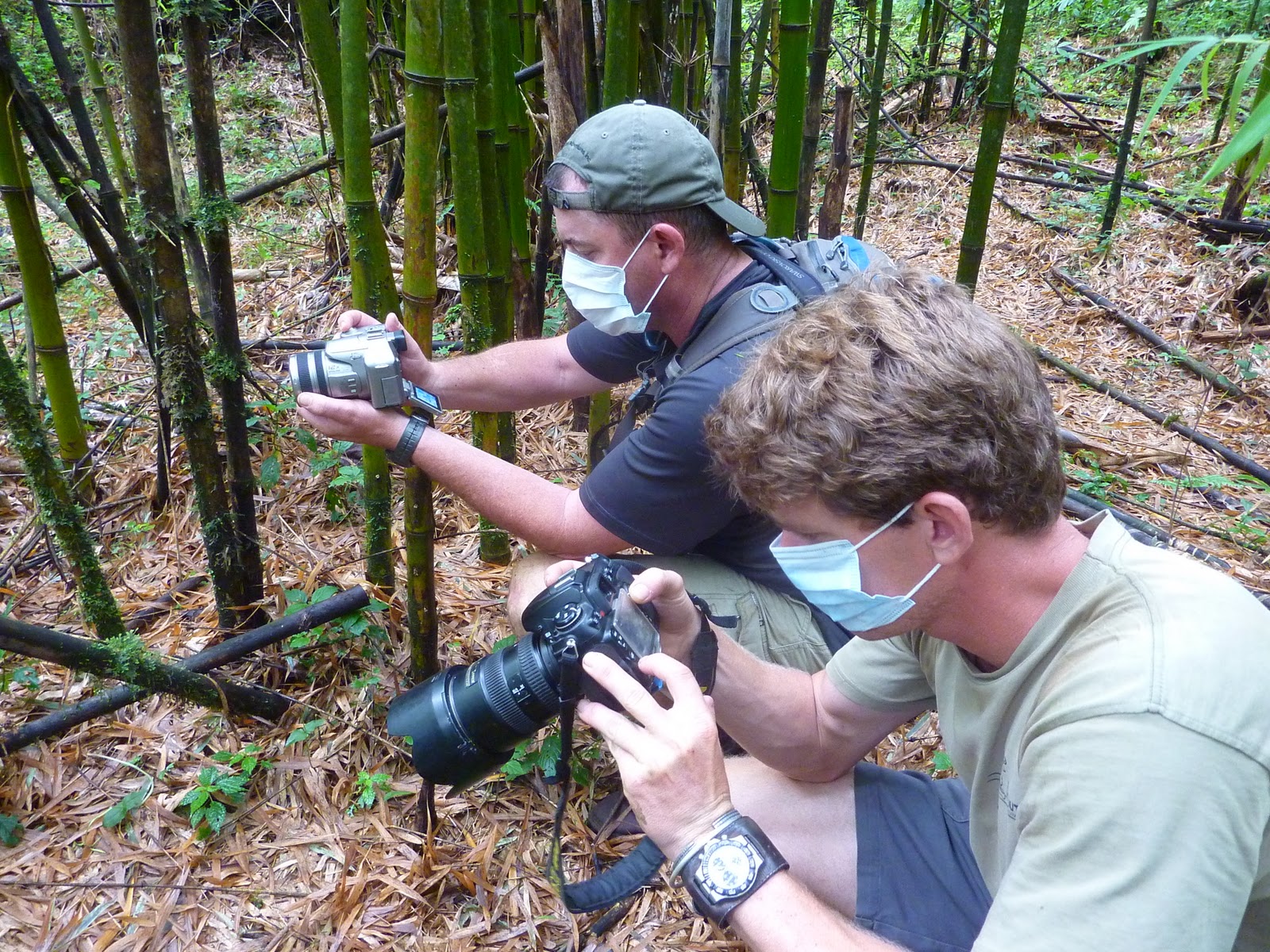
Donning our surgical masks, a precaution to protect gorillas from the various diseases we potentially carry to which they have no natural immunity, we began the precious hour. Kabirizi, a large and intelligent Silverback, took control of the group in 1998 his predecessor was caught in crossfire between the army and rebels. He acquired more females fighting other silverbacks, and now holds one of the largest groups, nearly 5% of the world’s Mountain Gorillas. We followed the family as they moved through the bamboo forest feeding on shoots and young stems, and we were rewarded with some commanding viewing.


With only 820 Mountain Gorillas left, a human disease would be a disaster.
The next morning we found the Humba group (14 individuals) and again enjoyed their calm company for the hour we were allowed. Although there is a minimum distance from which to observe the gorillas, it is sometimes impossible to get out of the way quickly enough should they walk toward you. At one point, when we were backed up against a bamboo clump, I was thrilled at the trust a female showed. Casually walking past us, her tiny baby clinging to her side, she stopped only a few meters away to pull a piece of Sticky-willy that had stuck to the baby’s hair.


Congo I: Journey to Congo


There are a few experiences on safari that rate themselves as extra special above others. There’s something about walking through the bush where you become vulnerable, or sitting in the midst of elephants with their intimate social interactions. I highly rate sitting on a hill with a 360 degree view with hundreds of thousands of wildebeest gnu-ing around you, but I don’t think there’s much that can prepare you for that 1 hour with a gorilla family.

The 300kg Silverback crosses his arms and stares at you, then scratches his head, while a youngster looks at you and then does a summersault before looking back at you as if he wants to know that you’re still watching, or if you’re going to play.
The Virunga Volcanoes
I knew our trip to see Congo’s gorillas was going to be a real adventure when we crossed the border at Goma. We spoke to the immigration official in Swahili, handing him our passports and photocopies of our visa approval through the window with Expats written over the top. I don’t want to dwell on the pessimistic perspectives of Congo written up in most articles, but the stories of officials confiscating passports and then demanding bribes or “recovery fees” did pass through my mind. He reached to a drawer in his desk and pulled out a cardboard folder with a hand-written piece of paper with a list of names, nationalities, and passport numbers. Our names were all spelled correctly, but the nationalities were jumbled not to mention the passport numbers. It didn’t seem to matter and he nonchalantly ticked our names off and corrected the nationalities. Our passports were passed to another official along with some mutterings in French, while we waited for the $50, 14-day visa, recently negotiated by the conservation body for tourists.

We stopped at the ICCN office to pick up our permits before driving north to the park headquarters and newly built Mikeno Lodge. The excitement was hard to contain. In stark contrast to Rwanda where the roads that tourists see are all paved and clean, and the experience offered a highly polished and organized system that you’d expect in Switzerland, Congo was the opposite.
Like any other town?
Goma itself is a town occupied by the UN- mostly Uruguayan, Indian and South African troops who live in fortified compounds with watchtowers and drive around in jeeps and helicopters spending approximately $3million per day. Congolese soldiers walk around heavily armed with Kalashnikovs, RPD’s and rocket launchers, while pickups with music systems and flags blast political slogans and music, campaigning for the up-coming elections.

Blood hounds being trained to help rangers.


As we drove through the countryside we were astonished at the number of children running out to give thumbs-up and ask for pens and biscuits. As in Rwanda, the volcanic soils are intensively farmed and appear very productive, just less orderly. We remarked how few were the small kiosks selling basic necessities like soap. It is obviously a hard life and everywhere we looked, the scene cried out with a story. As we drove into the headquarters on the edge of the forest, one could not help notice the old grand administrative buildings that spoke of a different era. Yet despite the evidence of deterioration, the result of decades of turmoil, there is an atmosphere of hope and positive change. 
(photos by Gian Schachenmann)

Beautiful rooms at Mikeno Lodge.
A wonderful breakfast before gorilla day.... stay tuned!

Tanzania's Great Rift Valley Lakes & Mountains

As if the dry season is attempting its final life sapping effort to suffocate us before the rains come, an apocalyptic dust storm is sweeping across the southern shore of Lake Natron. Agitated by the dark, threatening thunderstorm, the dust is diffusing the afternoon rays of sun giving Oldonyo Lengai an eerie glow as the dust slowly envelopes the volcano.

Driving from Amboseli to Lake Natron the other day, I took a cross-country route through the plains between four prominent volcanoes. The volcanic dust, like talcum powder enveloped the vehicle billowing into the car through every space possible. Building cumulonimbus clouds inspired graphic dust devils on the barren landscape. Zebra, Fringe-eared oryx, Grant’s gazelle, Thomson’s gazelle and giraffe stood in the shade of the few Acacia trees resting in the heat of the day.

Lake Natron, where we’re headed is the largest of the Great Rift Valley’s soda lakes and is also the most caustic lake in the world. It is extremely shallow, no more than 3 meters deep. Lying at 610m above sea level it also gets extremely warm and water temperatures regularly reach 40C (60C recorded), combined with a pH of 9-10, it’s surprising that life can actually flourish. Microorganisms that love the salt give it amazing shades of red, greens and crystal white.

Lesser Flamingos use this lake as an important breeding ground, protecting their eggs and hatchlings by building little mounds in the water far enough away from the shore that predators have to seriously think about venturing out. They also specialize in feeding on the algae- Spirulina that blooms in these waters. There’s also an endemic fish- the Magadi Tilapia that concentrate in the hot springs that feed into the lake.

A year ago, travelling with Nick Brandt on safari, we drove to Natron in search of calcified birds. We scoured the shores picking up a variety of birds including hornbills, flamingoes, starlings, doves, bee-eaters, mouse-birds, and Quelea that had been mummified by the salts in the water. The small invertebrates, fish, and bats that stood frozen in their death pose were fascinating. Click to see his photos of what we found.

A mixture of Sodium bi-carbonate (baking soda) and Sodium carbonate is called Natron, and is the same substance that was mined in Wadi el Natron in Egypt 5000 years ago by the Egyptians when they began mummifying their pharaohs. The alkali salt loves water and absorbs it, drying whatever it has come in contact with. Its alkalinity is also anti-bacterial which helps to stop bacterial decay.


A few days after we arrived here, it rained. The dust finally settled, and you could almost hear the animals breathing a sigh of relief. We drove out into the plains in front of Kitumbeine Mountain visiting all the little parasitic craters at the base of Gelai, Kerimasi and Oldonyo Lengai. The green grass already sprouting, we counted hundreds of zebra and wildebeest on the plains and spent some time just sitting and watching. In the evening we drove up Lengai as far as the track goes and sat watching the afternoon light sending moving shadows through the valleys and ridges, reflecting Shompole in the lake. 

Another Weekend in Tarangire


Finding myself back in Arusha for a couple weeks between safaris, it wasn’t long before I was wishing I was back out in the bush. With guests going into Matembezi’s private camp in Tarangire, I was invited by the owner to head out and spend the weekend there before the guests arrived on the Monday. The fridge full of beer, binoculars on the dash, and a spare set of clothes and other essentials, we left the traffic jams and noise of Arusha on the familiar road to Tarangire.

Looking through my blog it hadn’t occurred to me how much time I’d spent this year in Tarangire and after this weekend, I have to admit scores very high on my favorite places list. I was excited to get out there with my brother, girlfriend and some other friends not working as the guide or teacher, but just for fun. I’d get to look at some of the little-brown-jobs (LBJ’s) as birders call them, or stop to try to identify a fairly non-descript plant.

Just the drive into camp was wonderful, the 500 elephants in the swamp beginning to head out into the woodlands, a leopard in a tree next to the road. A lion in a tree, 3 pythons in trees, and of course the tranquil vistas. Maybe its because this was the first park my parents brought me to as an infant, but it always has a calming effect on my soul.

We woke up early on Saturday morning and drove out towards the swamp onto a beautiful green lawn, the result of a grassfire followed by rain. Within 300 meters from camp we spotted two lionesses feeding on a hartebeest and then watched as a hyena approached, urging the lioness to drag the carcass into the bushes. Surrounding us was an aggregation of Bohor reedbuck, Impala, Grant’s gazelle, Hartebeest, Eland and even a rare Fringe-eared Oryx wandered past, as we sat on the roof sipping fresh coffee. We continued on our little game drive only to bump into a pride of 14 lions- 10 cubs and 4 lionesses, before returning to camp for breakfast.


The Sausage trees were flowering and attracted Scarlet-chested Sunbirds who flitted about chasing each other away from their flowers. But the real highlight was the number of antelope that the fallen flowers attracted. At any one time, we could see at least 7 different species and all in all we saw a total of 12 species within a couple kilometers from the camp. The burned ground had also attracted a species of bird that I’d never seen before called the Chestnut Sparrow-lark as well as beautiful Collared Pratincoles.

Sunday came, and we returned to Arusha, revived by a couple nights in the African bush.

Antelope species seen:

1.     Eland Taurotragus oryx
2.     Greater kudu Tragelaphus strepiceros
3.     Lesser kudu Tragelaphus imberbis
4.     Bushbuck Tragelaphus scriptus
5.      Fringe-eared oryx Oryx beisa callotis
6.     Common waterbuck Kobus ellipsiprymnus
7.     Bohor reedbuck Redunca redunca
8.     Coke’s hartebeest Alcelaphus buselaphus cokii
9.     Grant gazelle Gazella granti
10.  Impala Aepyceros melampus
11.  Kirk’s dikdik Madoqua kirki
12.  Steenbok Raphicerus campestris

Places With No Roads to Them


...Oh, give us pleasure in the flowers today;
And give us not to think so far away... Robert Frost

The lesser kudu cautiously tip-toed into the clearing around the muddy waterhole. We froze as the male stared right at us. Somehow he didn’t see us and followed his little harem and young nibbling at some Cordia. Our senses keen our footsteps sounded much louder than they were as we shadowed them. The slight breeze in our faces was perfect as we took cover in a Gardenia overlooking the waterhole. The 4 kudu we had followed were joined by 5 more, including a beautiful male and they nervously drank from the left-over rain water. A sausage tree spread its dark green leaves and we hoped the shy antelope would come towards us to feed on the flowers that lay scattered at the bottom.
Kigelia africana


Startled, the kudu barked- a false alarm as a female waterbuck walked into the water with her calf, then the low rumble that only elephants can make. We huddled a little closer as a young male marched onto the scene. Acting as if he owned the place, he marched into the water then suddenly realizing he was alone turned and ran back to the matriarch who had appeared with her two other young. We could hear them breathe and the sounds of camera shutters sounded as loud as gunshots. Silently they turned to face us as if to follow the path we had come in on. We whispered to keep still and keep quiet when they too changed their plan and as silently as they’d arrived, disappeared. 


Turkana by Helicopter, Serengeti by Cruiser

Coffee break on the east ridge overlooking Lake Turkana
The Nyiru Range
Silenced by earmuffs, we lifted-off effortlessly floating up and over the 9000ft range of Mt. Nyiru in northern Kenya. The impenetrable forest of moss and orchid shroud Pencil cedars, olives, and aloes gave way as we dropped down over the cliff, hovering momentarily to breathe in the eroded cliffs of these ancient rocks. The helicopter changed angle and we surged forward, northward, accelerating through the valleys and watching the landscape dry. Herds of goats picked their way through the seemingly barren rock and the odd group of camels fed on the Acacia tortillis that had managed to establish themselves in the drought ridden soil. Inhospitable lava flows and boulder-ridden hillsides stretched out beneath us as we raced up the Great Rift-valley to the shores of Lake Turkana. As we flew the abrupt shoreline, fishermen waved and crocodiles dove into the water.

We were on our way to Ileret where Richard Leakey and Stony Brook University had set up a research station, the Turkana Basin Research Institute. Hot, windy and in a not-particularly-beautiful scrub it was hard to imagine that this land hid many of the secrets of human ancestry as well as the fossils of many of the predecessors of today’s vertebrate animals. A massive crocodile skull lay on the cement floor outside the door of a lab where a few individuals sat, eyes glued to microscopes while their hands manipulated little bits of fossilized bones and high-tech cleaning brushes. Behind it, catalogued boxes stood on shelves housing the finished secrets of their work.
Dinosaur bones (Dinosaurs became extinct 65 million years-ago).
Natural rock slide at Desert Rose
This wasn’t an ordinary safari. Starting in Meru National Park to get a taste of game, we ending in Serengeti National Park to really feast our eyes. The major diversion to Lake Turkana was as much about having fun as experiencing this historically significant part of East Africa. The helicopters allowed us to stopover for a scrumptious lunch at Desert rose, named after the beautiful succulent (Adenium obesum), but not before we’d thoroughly cleaned the natural rock-slide of debris with our bums.
Sand dunes near the Soguta Valley

Grevy'z zebra (Meru National Park)
Beautiful tusker... one of the last.
Topi (Serengeti National Park)
Hyena (Serengeti National Park)
The safari defining wildlife-moment came when we camped in an exclusive luxury mobile camp in the very north of Serengeti National Park, in a small corner known as the Lamai wedge. Having seen nearly every other animal that we wanted the pressure was on us guides to try to find a famed wildebeest crossing. Conditions looked good. The wildebeest migration had arrived and some billowing storm clouds on the north side of the Mara-river beckoned the herds across. The wildebeest began cascading down the bank and I eased the vehicle down-wind and down-stream of the wildebeest. The quickening sound of thousands upon thousands of calves and their mothers, gnu-ing as they dove into the waters and emerged on the other side silenced the normally chattering kids in my vehicle. An annoyed hippo emerged, scaring the wildebeest and they drifted downstream, now coming up on both sides of the vehicle at about 300 per minute. I estimate the average crossing rate to be 200 per minute, and when we left 2.5hrs later I estimated that over 30,000 had crossed the river.
Wildebeest crossing the Mara River.