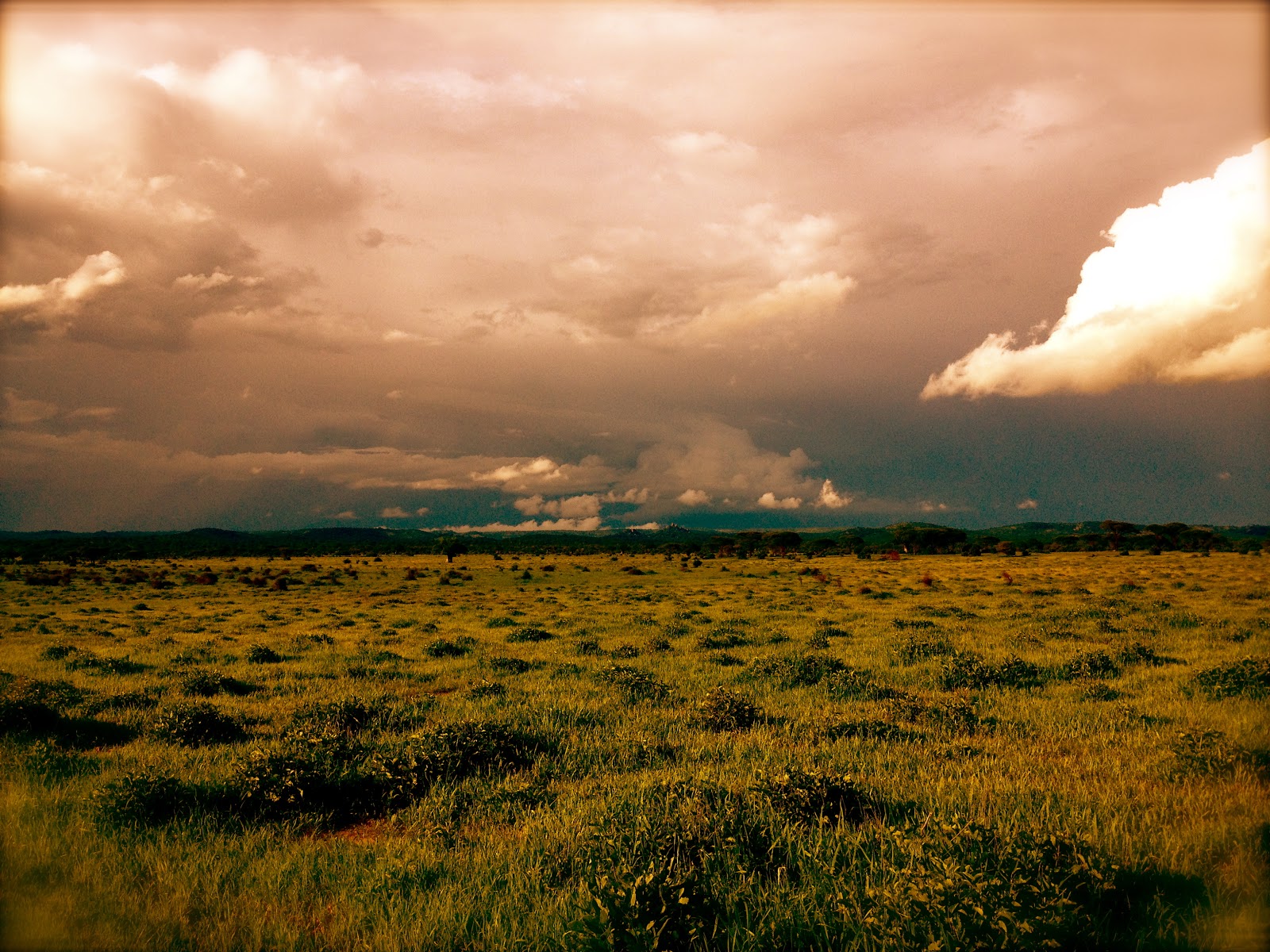
The Guide Training Season.


‘At its best, interpretation is a whisper in the visitor’s ear.  It suggests ways of looking, plants seeds that may take root in the field of a visitor’s own thoughts, while leaving them free to explore for themselves.’ James Carter


As the guide training season draws to a close, I thought I would share a few highlights and thoughts on my guide training philosophy and what I actually do during guide training.


From the 2nd of April until the 1st of May, my home became a tent, as it often does. My tools include: a duffel of clothes, a flashlight, my binoculars, a trunk of books and various toys, from UV lights, to laser pointers, and i-phone apps. This month my training was exclusively for Asilia Lodges & Camps, a company that invests a small fortune in its guides.

Together with Lewis Mangaba, a distinguished guide from Zimbabwe with phenomenal knowledge, and 16 “trainees”, we set off to try to gain an understanding of how the world works. The month’s focus was to spend as much time in situ, learning ecological concepts and attempting to apply them to what we could find and what we could physically see. The abundance and diversity of what we call “charismatic wildlife” are incredible in this country, but all too often become the sole focus of a safari. You don’t have to watch too many David Attenborough documentaries to learn that nature is full of wonderful, weird, and crazy things going on - let alone on the savannahs of East Africa. It is our goal to influence guides to reveal and unravel some of these intricacies for their guests.
 
Lewis, inspiring.
During the past years I’ve been fortunate to co-train with various guides and as we draw near to the end of the training we realize how much we’ve learned from each other. Sometimes, it is just a different perspective or way of seeing something, but often it’s also an inspiration to learn more and discover more.
 
A dung beetle, forming a brood ball... do you have any idea how much dung we'd be wading through if it weren't for these little guys?
Grass identification.
But, all of this focuses on natural history and that’s not what guiding is all about, which is one of my major criticisms of the guide training/certification industry. Of course, it is necessary to have a baseline knowledge of ecology and to be able to identify most of the species of animals that you come across, but there’s so much more to guiding. At the very foundation, there’s plain and simple safety, and you’d be surprised at how many guides do not have adequate and up to date first aid knowledge, let alone certification.
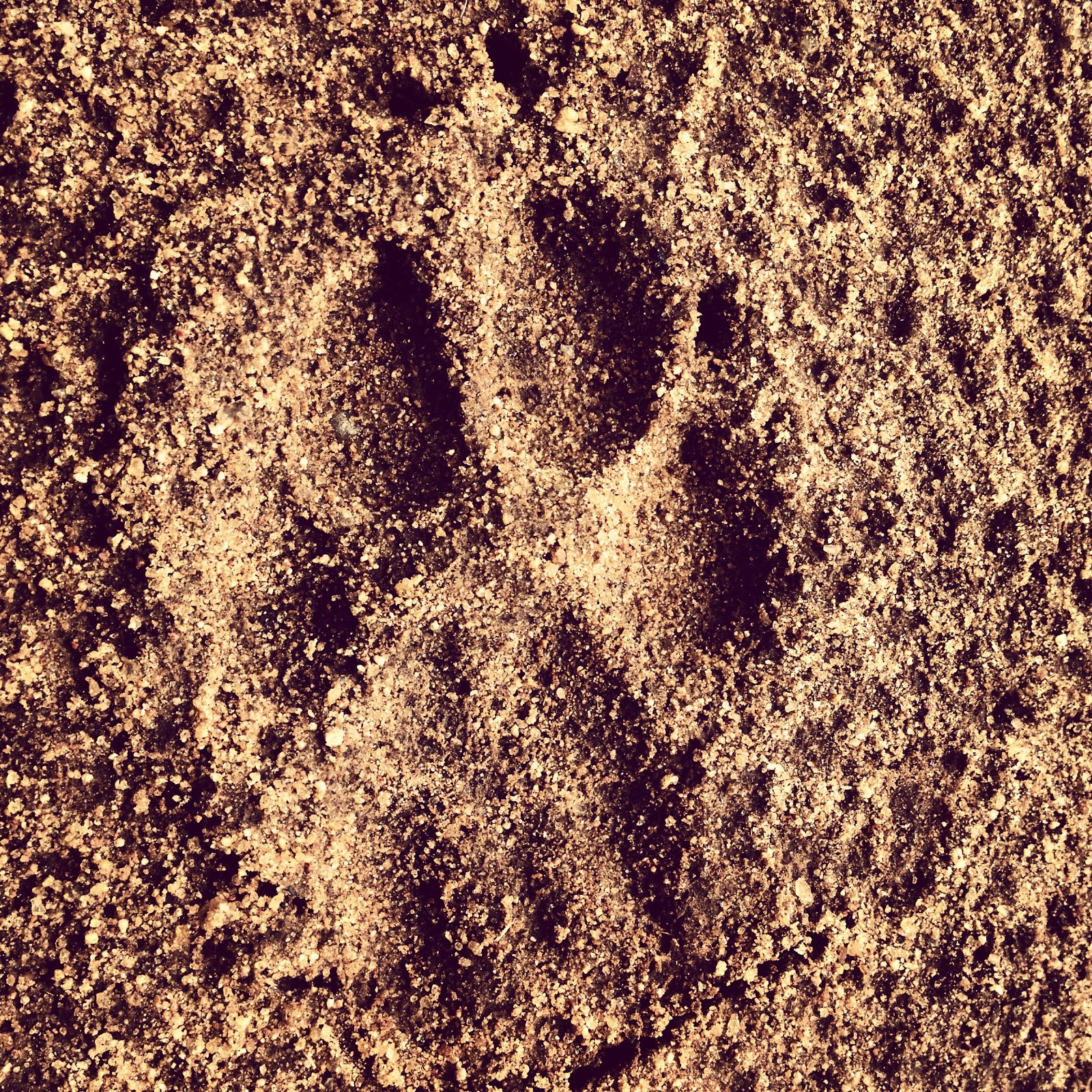
A track- 3 lobed pad, claw marks... this is a special cat.

This year’s training did not just involve the 16 “trainees,” who Lewis and I spent the whole time with, but an additional 43 guides from Asilia’s portfolio of camps in Kenya and Tanzania joined to get a valuable Wilderness Advanced First Aid certification and to take another course- Adaptive Human Behavior and Client Care. This interesting course was developed by Robin Peterson after an the initial 3 day course Myers Briggs course into what is now a 5-day level 1 and 5-day level 2 course. Not only does this course improve the guide’s ability to interact communicate effectively with the guests, but a guide’s life is improved being armed with a toolkit to deal with the many human relationships that they have at work and home. In addition to this course, they spent a day each with a hosting coach, behavioral ecologist, 2 bird guides and a photographer who coached them on how to use a camera. 

Training in Ruaha


-->
Squeezing a little ash out of an eye-dropper to get the subtle direction of the wind, a national park ranger chose his route. Approximately a hundred yards away a group of 4 elephant bulls were drinking water from a sand river having dug holes for sand-filtered water. Behind him 5 other rangers walked in single file together with a trainer.

Choosing his path carefully and using the river bank as cover, the ranger led his group toward the elephants. He eyed a spot approximately 25 yards from the elephants, downwind from them and with a good view, and he motioned with his hands to hunker down and follow his lead. After rechecking the wind, he relaxed and the group stood and watched, some of them kneeling as the elephants drank their fill. As they finished and silently began to move away, the ranger also rose and led his group away.

Meanwhile, a few kilometers away, another ranger was deciding where the safest place was to enjoy views of another small group of bulls that were moving toward another section of river. Finding a termite mound next to a big baobab tree with a good view, he stopped his group to watch the elephants walking by.

Simon Peterson and rangers discussing the approach.
These are two examples of over a hundred and twenty elephant approaches led by a group of 20 rangers in Tanzania’s remote Ruaha National Park as part of a training program I coordinated. During a Wilderness Advanced First Aid course led by Hewett Brown (A Wilderness Medical Associates instructor with Savanna Medics), the rangers learned Tanzania appropriate first aid skills not only to deal with emergencies and respond accordingly, but to recognize risky situations and prevent potential problems.
Getting ready for practice.


Simulated injuries.
Armed with their new found first aid skills, the rangers next participated in a firearms course. Familiar with automatic anti-personnel weapons used in anti-poaching patrols, the safe use of heavy caliber rifles used in walking safaris needed separate training as well as practice simulating charging animals. Under the guidance of Mark Radloff, a seasoned instructor, the rangers were put through drills to build muscle memory and improve their shooting.

Recovered bullets from the respective ammo.
Dry fire- practicing trigger control and sight picture.
Some ballistics theory.
With the knowledge that the rangers could deal with the medical aspects of an accident, and the knowledge that they could handle heavy caliber rifles safely and shoot accurately, we set off to try to ensure that they’d never have to actually use the first aid skills or ever have to shoot an animal. We covered all aspects of walking from necessary equipment, client briefings, walking formations, accidental encounters, and potentially dangerous animal behavior. We also practiced leading walks, being back-up ranger, and recognizing opportunities to provide unforgettable experiences all the while remaining safe.


My Big Year

2012 might to me be a year of milestones. I for instance turned 30, my dad turned 60, my safari and guide training business is entering its 5th year… and the Tanzania Bird Atlas Project reached its goal of 1 million records.  
I’ve decided in celebration that I’m going to do a Big Year starting Nov. 7th. Many people will know what a big year is from the Hollywood movie that came out last year. I don’t watch a lot of movies, but my girlfriend convinced me to watch this movie because it’s about birds. It might also be a coincidence that is the second year that I organized the on-the-ground logistics for a 23 day Tanzania endemic trip run by Birdquest in the UK, where they routinely score 490±3 species of birds.

Now Tanzania is one of the most diverse countries in the world, one that boasts 11% of the world’s bird species. If you have a bit of experience with birds and try, you can easily get over 100 species in a day. Friends of mine (Daudi Peterson, David Moyer, Jon Simonson, Mike Peterson), also mentors, recorded 318 species in a day, and when I was 14, I used to challenge myself to get over 60 species in a day just in the backyard.

Some of my friends and guests who have been on safari with me think I know every bird, but that’s the way I feel when I go birding with serious birders who know their LBJs. LBJs are Little Brown Jobbies or the little brown and grey birds that are really hard to identify. If it were up to me, I might have used slightly different language to describe those little things.  As much as I love birds, I hit the wall with those LBJs and there’s too much other stuff out there that is so intriguing that I’ve pursued some of them instead of challenging the wall, but… maybe it’s time to face it and break it.

It took me a while to find the world record for a world big year, but apparently it stands at 4,372 species. The couple who hold the record have their own blog http://www.thebiggesttwitch.com. Now, I’m not going to sell my house to fund around the world trip, and I had to promise my girlfriend I wouldn’t be the Bostiks guy. I haven’t spent hours strategizing, I don’t have an audio playback system to call rarer birds in, I really struggle with LBJs, but I do have a lot of friends who love birding and my work takes me to many different parts of Tanzania. My real motivation to do a big year is for fun. It’s a challenge and I’m going to need to focus (but not too much), but I’m not going to twitch (well I might a bit). I’m going to hope to get a lot of help from friends around Tanzania who know where to find local species… but ultimately I’m hoping to get a chance to learn a whole lot.

Lilac-breasted Roller (Ndutu)
So, if you’re keen, follow me on this celebration of Tanzanian biodiversity- here…

Hadza


A Hadza man tells me the names of different places.
A couple of weeks ago I took a family to spend a few days with the Hadza hunter-gatherers. The Hadza are a very interesting people to visit, not because of a complex society, but the opposite- beautiful simplicity. The Hadza speak a language full of clicks- not dissimilar to the bushmen of the Kalahari, yet linguistically distinct. They live almost entirely off roots, berries, honey and meat that they collect daily. The technology is so simple that there is no obligate reliance on anyone, so everyone is practically equal and independent. Their society is based on immediate return, not delayed return like most others so there is no need to accumulate food or amass wealth.
Not the stance they teach you in archery.
But an effective one..
Anthropologists studying hunter-gatherers and especially the Hadza see it as an opportunity to look into the past and try to understand how our ancestors probably lived. They’re not saying that the Hadza are backward or subhuman, but that the technology they use is probably very similar to the technology that the first humans used. By definition: “hunter-gathers are people who forage for wild foods, practicing no cultivation or animal husbandry (Marlow, 2010).” Because the environment that the Hadza live in is so similar and close to the habitat in which early homonid fossils have been found, they are the most relevant society to study from an evolutionary viewpoint.

Honey bee (Apis mellifera) larvae are a delicacy.
In a study conducted in the 80’s that scored different societies based on their complexity the Hadza (and Mbuti pygmies of Congo) scored 0 on the scale of 0-40 (Marlow, 2010). Hadza technology consists of a bow, arrows, and some men have an ax. Many also have a knife, and the women use sharpened sticks to dig for tubers. They make fire and light rolled cigarettes by using a fire drill.


Entrance tube of a Stingless bee (Trigona sp.) hive.

Pangolin


Who am I?

1.     I am a mammal.
2.     I belong to my own taxonomic order called Pholidota but I’m more closely related to Carnivores than other mammals.
3.     I am bipedal (which means I walk on my two back legs).
4.     I don’t have teeth so I have a very strong muscular stomach and sometimes I swallow sand to help grind my food.
5.     I can extend my tongue nearly half a meter and it is very thin. It isn’t attached to a hyoid bone like most mammals but instead it extends into my thorax.
6.     I spend a lot of time with my face in anthills and termite mounds so I have small eyes and my ears are basically just holes in my head.
7.     Some people refer to me as myrmecophagous.
8.     I am a very good digger and the claws on my hands are extremely tough.
9.     I have a heavy tail that I use as an anchor when I dig.
10. I have hard scales that even a lion can’t bite through so I roll up in a ball when I feel threatened.
11. Like most other one-of-a-kind animals, I’m threatened by the animal trade because my scales are used in Chinese medicine and witchcraft. If only they knew that they could chew their fingernails for the same effect- my scales, just like rhino horn is just keratin like fingernails.


Wilderness walking, Oldonyo Lengai and Serengeti


Shedding the high thread count cotton linen and 5 course meals (luxuries of the semi-permanent and permanent lodges and camps I usually use) and braving the elements, an adventurous group of guests and I set off on safari. After having successfully climbed Mt. Kilimanjaro, including the 10 year old and 12 year old in the group (thanks to the professional climbing outfit I use, Summits-Africa), they were excited for their next experience. My ten days with them can be divided into 3 chapters: Wilderness, the Rift Valley, and of course, Serengeti.

Gourmet bacon, scrambled eggs and cowboy coffee cooked over an open fire.
Wilderness

We left Arusha in one of my new open Land Rovers which immediately added an air of excitement, followed by my trusty Land Cruiser. A private lightweight camp had been set up for us in a special campsite just on the edge of where most people get to in one of my favorite national parks in Tanzania: Tarangire. When the focus is on a wilderness experience, you sacrifice the wildlife abundance that you get in the core tourist areas, but with the right guide, you get to immerse yourself in nature.  The encounters you have with wildlife become much more meaningful and so much more than just about the wildlife.
Three bull buffaloes visit a water hole while we quietly watch downwind of them.
We didn’t really sacrifice comfort. None of us were cold, and we had warm duvets to keep us warm at night. There was always cold beer, gin & tonics at the end of the day, and the scotch was good around the fire after dinner. We even had hot showers. The coffee in the morning was proper and hot. But, yes, there were moments when the sun was beating down, and when we got dust in our eyes. We woke up a couple of mornings having not slept all that well, but it was because of the excitement of hearing a leopard on patrol, and the hyenas whooping.

Rift Valley

Having enjoyed our wilderness experience, we ventured on, taking advantage of the lightweight camp to see another part of the Tarangire ecosystem that most guests to Tanzania don’t get to see. During the wet season, just like in the Serengeti ecosystem, the volcanic grasslands of the Rift Valley draw 10,000 wildebeest (10% of what there once were) to feed on nutrient rich grasses and calve. But during the rest of the year, the valley is dry and harsh. The fertile soil turns to talcum powder dust that feeds tornado-like dust devils, and the volcanic rocks and lava flows violently shake any vehicle that drives those roads. Yet, despite the harshness, Maasai pastoralists eke out a living, herding cattle across the grasslands, and large herds of zebra with their hardy digestive systems feed on the dry grasses that remain. And then, as you come around the corner, Oldonyo Lengai seems to rise out from the plain in front of you.

Under the light of the moon, we attempted began our summit bid. The views from the top are beautiful, but the climb is brutal. Volcanic ash fills your boots, and you slip constantly. There are no switch-backs, just a 5 hr, 6000ft ascent. Since its eruption in 2008, you can no longer walk out into the crater filled with lava and ash. Instead, the mountain is higher than it used to be and the crater a deep, deep hole.
 That afternoon, after napping and eating, we drove to the edge of Lake Natron in search of Lesser Flamingos. Lake Natron lies at a low point in the rift. It has no outlets, and with high surface temperatures and wind, the water in it evaporates leaving behind salt deposits that make it as alkaline as ammonia.  These conditions are perfect for Cyanobacteria to flourish. Lesser flamingos are Cyanobacteria specialists and use Lake Natron as a nesting ground.
A few thousand Lesser flamingos through the eyepiece of my binoculars.
Serengeti
 
A lovely herd of giraffe... yes, those black dots in the background are wildebeest.
Having completed another chapter of our adventure, we climbed back into the vehicle and headed up the few million year-old rift and up and over the 580 million year-old Gol Mountains to northern Serengeti. Unusually dry for August, I was a little worried that the wildebeest migration might have already disappeared across the river into Kenya’s Mara. Again we chose to spend most of the time avoiding the other vehicles and bumbled around finding our own lions, except for one drive that took us towards the confluence of the Bologonja and Mara rivers to see the thousands of wildebeest. The rest of the time we took the opportunity to be quiet and capture the ambient sounds of the bush on film, sipping champagne in celebration of a wonderful experience and 69th birthday, and watching a threatening thunderstorm bear down.
Finding predators is always very satisfying although most of the time they are sleeping.
 
Post note: The group continued to Mt. Kenya where they successfully climbed to Point Lenana, the highest point on the mountain that doesn’t require technical climbing. Well done!

Celebratory Safari


The moon rises as we enjoy sitting around a fire.

The new season kicked off to a wonderful celebratory safari for a well-earned birthday. Two nights in Ngorongoro, three in Serengeti and then a four-day Rwanda trip to see the Mountain Gorillas made for a sweet safari. So here's how we celebrated:
After breakfast on the verandah of the tent, we went for a game drive. Driving around a bush we encountered this impala giving birth- which seemed fitting for a birthday sighting.
The landscapes in northern Serengeti provide a quintessential backdrop to the wildlife sightings in the area. These 500 million year old kopjies provide refuge for lions and leopards. Rock-splitting fig trees (Ficus glumosa) find tiny spaces to establish themselves sending their roots through the cracks in the rocks. Some of them are very old like the one below.
What a perfect tree to have a picnic lunch! The rock at the base was also the perfect table top.

Rounding off the day with sun-downers on a rock with a view.
The celebrations continued in Rwanda with two gorilla treks. Gorilla groups are named after the silverback, the dominant male. We treked to Kwitonda group where this little rascal entertained us for nearly half an hour, and the next day to Agashya group where the weather made it too dark to photograph or film. The Agashya gorillas retreated in the mist and sat in a semi-circle in a cathedral of bamboo.
Kwitonda, the dominant silverback has 4 females and 14 children. He is accompanied by 2 other silverbacks
Gorilla individuals are easily (easily to some) identified by the unique pattern of wrinkles on their nose. By comparing nose prints on the family tree above and the rascal in the video below, I believe his name is Karibu.